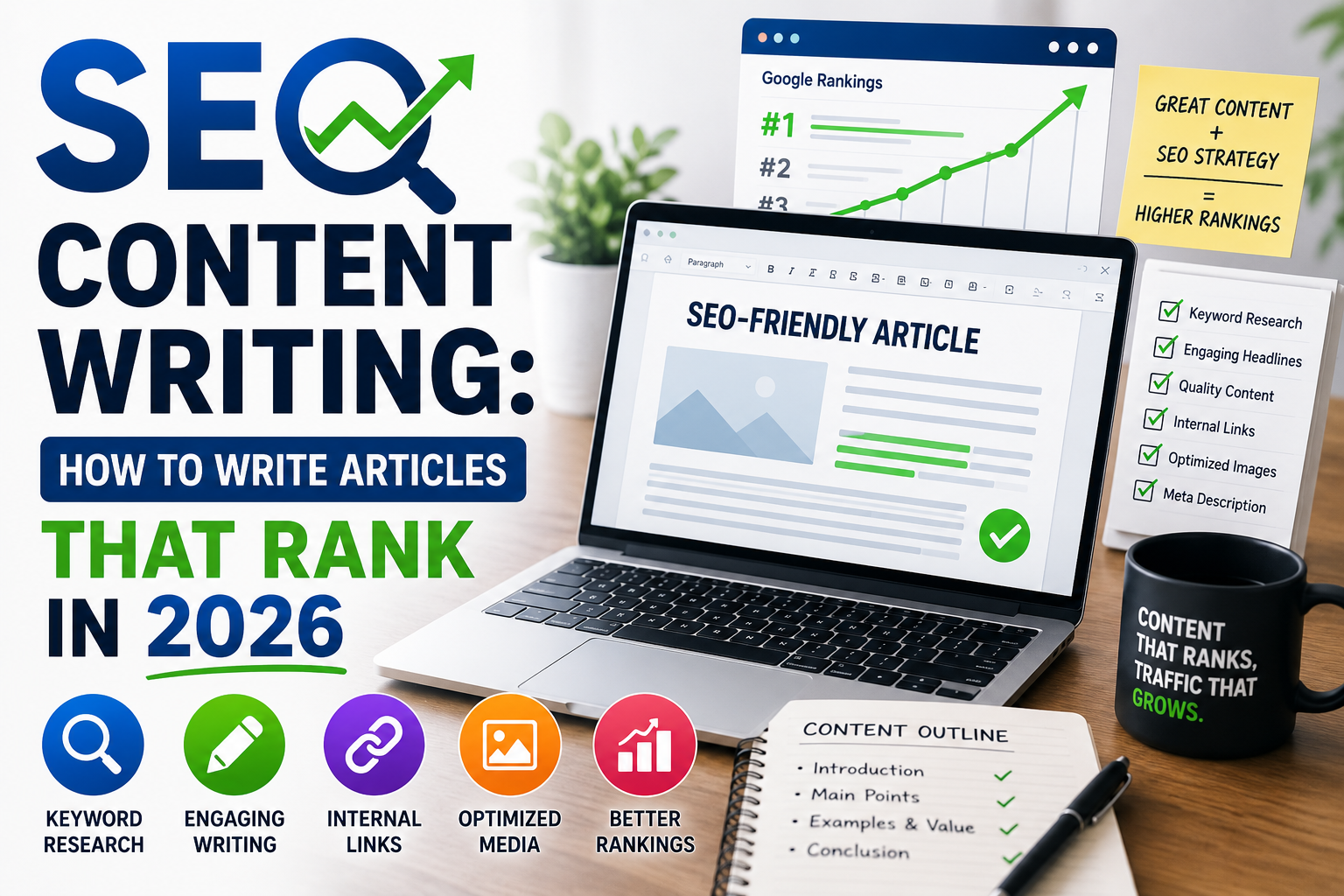
Quick Answer (AI Overview Snippet): SEO content writing in 2026 means producing articles that satisfy search intent completely while being structured for both human readers and AI retrieval: research the query and the SERP before outlining, lead every section with a direct answer, place keywords naturally in the title, H1, intro and headings, demonstrate first-hand experience, cite statistics with sources, format with short paragraphs, lists and tables, interlink the topic cluster, and edit ruthlessly for clarity. Word count follows coverage — never the reverse.
Introduction: The Gap Between Writing and Ranking
Thousands of well-written articles are published every day that will never receive a single organic visitor. The prose is clean, the ideas are sound — and the pages are invisible, because writing well and writing to rank are overlapping but distinct crafts. Ranking content is engineered before the first sentence: the query is chosen deliberately, the intent is verified against the live SERP, the structure is built for extraction, and the expertise is made visible rather than assumed.
In 2026 the craft has a third audience. Beyond the human reader and the ranking algorithm, every article is now read by language models deciding what to lift into AI Overviews and assistant answers. The good news is that all three audiences reward the same fundamentals — directness, structure, evidence, and genuine expertise — which means one disciplined process serves the entire stack.
This guide from Webin Marketing is that process, end to end: research, outlining, drafting, optimizing, and editing. It is the writing-level companion to our on-page SEO checklist — that article covers the page; this one covers the words.
Phase 1: Before You Write a Word
Choose the Query, Then Interrogate the SERP
Every ranking article begins as a keyword decision made with proper keyword research: a primary query with confirmed demand, winnable competition, and business relevance. Then search it and study the first page like a detective:
- What format ranks? Listicles, how-to guides, comparison tables, definitions? The SERP is announcing the intent — write the format it rewards, not the format you prefer.
- What do the top results cover? List their H2s. The union of their sections is your minimum coverage; the questions they answer badly are your opportunity.
- What does People Also Ask reveal? Those questions become headings, FAQ entries, and the sub-queries AI systems fan out into.
- Who ranks? If every result is a major authority and your domain is young, pick a more specific variant of the query you can actually win.
Define the Reader and the Job
One sentence before outlining: “This article helps [specific reader] accomplish [specific outcome].” Every section either serves that sentence or gets cut. Content written for “everyone interested in marketing” ranks for no one; content written for “a store owner deciding whether to fix site speed themselves” has a voice, a depth level, and a natural keyword vocabulary built in.
Phase 2: The Outline Is the Strategy
Strong articles are won at the outline stage. Build it as a question hierarchy:
- H1: the primary query as a compelling promise.
- Quick answer block: 40–70 words directly answering the core question — your featured-snippet and AI-citation candidate, written before anything else so the article has a thesis.
- H2s: the major sub-questions in the order a curious reader would ask them, phrased the way searchers phrase them.
- H3s: steps, examples, and components under each H2.
- Planned assets: mark where a table, list, original image, or statistic belongs — formats are decided in the outline, not improvised in the draft.
- Link plan: which cluster articles this piece will cite, and which pages will be updated to cite it back.
An outline this complete makes drafting fast and coverage gaps impossible — the two chronic failures of “just start writing.”
Phase 3: Drafting — The Rules That Move Rankings
Lead Every Section With the Answer
The inverted pyramid, applied at section level: the first one or two sentences under any heading should completely answer that heading’s question, with elaboration after. Readers scanning get value instantly; snippet systems get clean extractions; language models get liftable passages. This single habit separates content that gets cited from content that gets paraphrased without credit.
Place Keywords Like a Professional, Not a Robot
The primary keyword belongs in the title, the H1, the first 100 words, at least one H2, and naturally a few times through the body — and then your counting stops. From there, write with the full vocabulary of the topic: synonyms, related entities, the terms experts actually use. Modern systems evaluate topical depth semantically; the article that mentions LCP, render-blocking, and hero images while discussing page speed reads as expert, while the article repeating “page speed optimization” fourteen times reads as 2012.
Show Experience or Borrow It Honestly
The decisive quality differentiator in 2026 is demonstrated first-hand experience — the E in E-E-A-T that mass-produced content cannot fake. Include what you actually observed: client results with numbers, screenshots of real settings, the mistake you made and corrected, the timeline things really took. If you lack direct experience, borrow it transparently — interview a practitioner, quote them with name and title, cite their data. “We tested this across twelve client stores” is worth more than three hundred words of generic explanation.
Evidence Every Claim
Specific statistics with linked credible sources transform assertions into citable facts. “Page speed matters” is filler; “Google’s research associates each added second of mobile load time with sharply higher bounce probability” with a source is evidence. Three to five sourced statistics per article is a healthy floor — they strengthen reader trust, rater assessment, and AI citation probability simultaneously, a triple payoff documented since the earliest generative-engine research we covered in our GEO guide.
Format for the Scanning Reader
Paragraphs of two to four lines. A bulleted or numbered list whenever three or more items occur in series. A table whenever two or more things are compared across attributes. Bold sparingly for genuinely key phrases. Subheadings every 150–300 words. These are not cosmetic choices: formatting determines dwell time, dwell time reflects satisfaction, and satisfaction is what every ranking system ultimately models.
Phase 4: The Optimization Pass
Draft complete, run the deliberate pass:
| Check | Standard |
| Title tag | Under 60 characters, keyword-led, includes a click reason |
| Meta description | 140–155 characters, keyword present, benefit + implicit CTA |
| Quick answer | Present, 40–70 words, genuinely complete |
| Heading audit | One H1; H2/H3s are real questions; logical hierarchy |
| Internal links | 3–6 to cluster pages with descriptive anchors; reciprocal links scheduled |
| External links | 2–4 to authoritative sources backing your statistics |
| Images | Original where possible, compressed, named, alt-texted per our image SEO practices |
| FAQ | 4–6 real questions with concise answers; FAQPage schema if visible |
| Author | Named byline linking to a credentialed bio |
| Cannibalisation | No existing page targets this primary query |
Phase 5: Edit Like Rankings Depend on It — They Do
The edit is where good drafts become ranking pages:
- Cut the throat-clearing. Delete the first paragraph if the second works without it; it usually does. Every “in today’s fast-paced digital world” costs you readers before value arrives.
- Read answers aloud. Anything that sounds unnatural spoken will fail the snippet, the voice result, and the human — the same test from our voice search guide.
- Hunt hedge words. “Might possibly help in some cases” signals an author who doesn’t know; experts commit, with stated conditions.
- Verify every fact and link. One wrong statistic undermines the trust the other twenty built.
- Check the promise. Does the article fully deliver what the title and quick answer promised? Partial delivery is the silent killer of rankings — pogo-sticking readers tell the algorithm everything.
Writing With AI Without Writing Like AI
AI assistants belong in the modern writing workflow — for research synthesis, outline drafts, heading variants, and first-pass prose — but the publishable article requires the human layer machines cannot supply: your actual experience, your verified facts, your editorial judgment about what this specific reader needs. The reliable division of labour: AI accelerates structure and drafts; humans contribute evidence, examples, opinions, and final accuracy. Publishing raw model output fails on exactly the dimensions that now decide rankings — experience, originality, and trust — while a practitioner using AI to write faster *with* those qualities gains pure speed. Disclose your process if your editorial standards call for it, and never let the tool’s fluency substitute for your knowledge.
How Long Should SEO Content Be?
The honest answer: exactly as long as complete coverage requires, and no longer. Word count is not a ranking factor; coverage and satisfaction are. A precise 900-word answer outranks a padded 3,000-word essay on the same query, while a genuinely complex topic legitimately needs 2,500+ words to cover. Derive length from your SERP analysis — what depth do winning pages reach, what do they miss — and from your outline’s question list. When sections start existing to feed a word-count target rather than a reader question, the article is finished and the padding is hurting it.
The Refresh Cycle: Writing Never Ends
Top-performing articles are maintained assets, not finished products. Quarterly, for your most valuable pages: update statistics and dates, answer the new PAA questions that emerged, replace outdated screenshots and recommendations, strengthen internal links to newer cluster pieces, and re-verify the SERP intent hasn’t shifted formats. Pages refreshed on this cycle defend rankings through algorithm updates and routinely reclaim lost snippets — the compounding advantage of treating content as a portfolio under management rather than an archive.
Putting It Together: One Article, Start to Finish
Watch the process run once. The query “how to reduce cart abandonment” is chosen from the keyword map: commercial-informational intent, winnable difficulty, direct business relevance for an ecommerce audience. The SERP shows listicle-guides averaging twelve tactics with weak coverage of WhatsApp recovery and India-specific payment failure — two gaps a practitioner can own. The outline assembles: H1 promising proven tactics with a number, a 60-word quick answer naming the top three causes and fixes, H2s phrased as the PAA questions (“Why do customers abandon carts?”, “What is a good abandonment rate?”), an H2 per tactic with the answer in its first sentence, a benchmark table with sourced statistics, and two planned screenshots from a real recovery sequence. Drafting takes the morning because the outline made every decision already; the optimization pass installs the title, meta, links into the checkout-optimization cluster, and FAQ schema; the edit deletes the warm-up paragraph, commits the hedged claims, and reads the answers aloud. The piece ships with a named author who has actually run the sequences shown — and three months later it holds the snippet for two question variants while feeding internal authority to the money pages it links. Nothing in that sequence required talent that can’t be trained; all of it required refusing to skip steps.
Common SEO Writing Mistakes
- Writing the article, then looking for keywords it might rank for
- Matching your preferred format instead of the SERP’s rewarded format
- Burying answers under wind-up paragraphs and personal essays
- Keyword repetition where topical vocabulary should be
- Zero original experience, evidence, or named authorship
- Walls of unbroken prose with no lists, tables, or visual relief
- Publishing into cannibalisation against your own existing pages
- Never refreshing — and losing to the competitor who does
Frequently Asked Questions About SEO Content Writing
What is SEO content writing in simple terms?
How many keywords should I use in an article?
Can AI write my SEO content?
How often should I publish new content?
What is the ideal article length for SEO?
How do I write content for AI Overviews specifically?
Conclusion: Engineer First, Then Write Beautifully
Ranking content is not better-written content — it is better-engineered content that is also well written. Choose queries deliberately, let the SERP dictate format, outline as a question hierarchy, answer first in every section, prove your experience, evidence your claims, format for scanners, and edit without mercy. Do that consistently and the three audiences that matter — readers, rankings, and the AI systems building answers — all reach the same verdict about your pages.
If you would rather have this process run by a team that does it daily, Webin Marketing’s content and SEO services deliver fully engineered, ready-to-rank articles for businesses across India and worldwide — research, writing, optimization, and refresh cycles included. Book a free strategy call and we will show you the exact content gaps between you and the pages currently winning your keywords.
Affiliate Disclosure
Some links in this article may be affiliate links. If you purchase a tool or service through these links, Webin Marketing may earn a small commission at no extra cost to you. We only recommend tools we have tested or genuinely believe add value to our readers.
Disclaimer
This article is for informational and educational purposes only. Search systems and content guidelines evolve continuously, and no agency can guarantee specific rankings or traffic outcomes. Results depend on niche, competition, site authority, and execution quality; validate every practice against your own analytics.