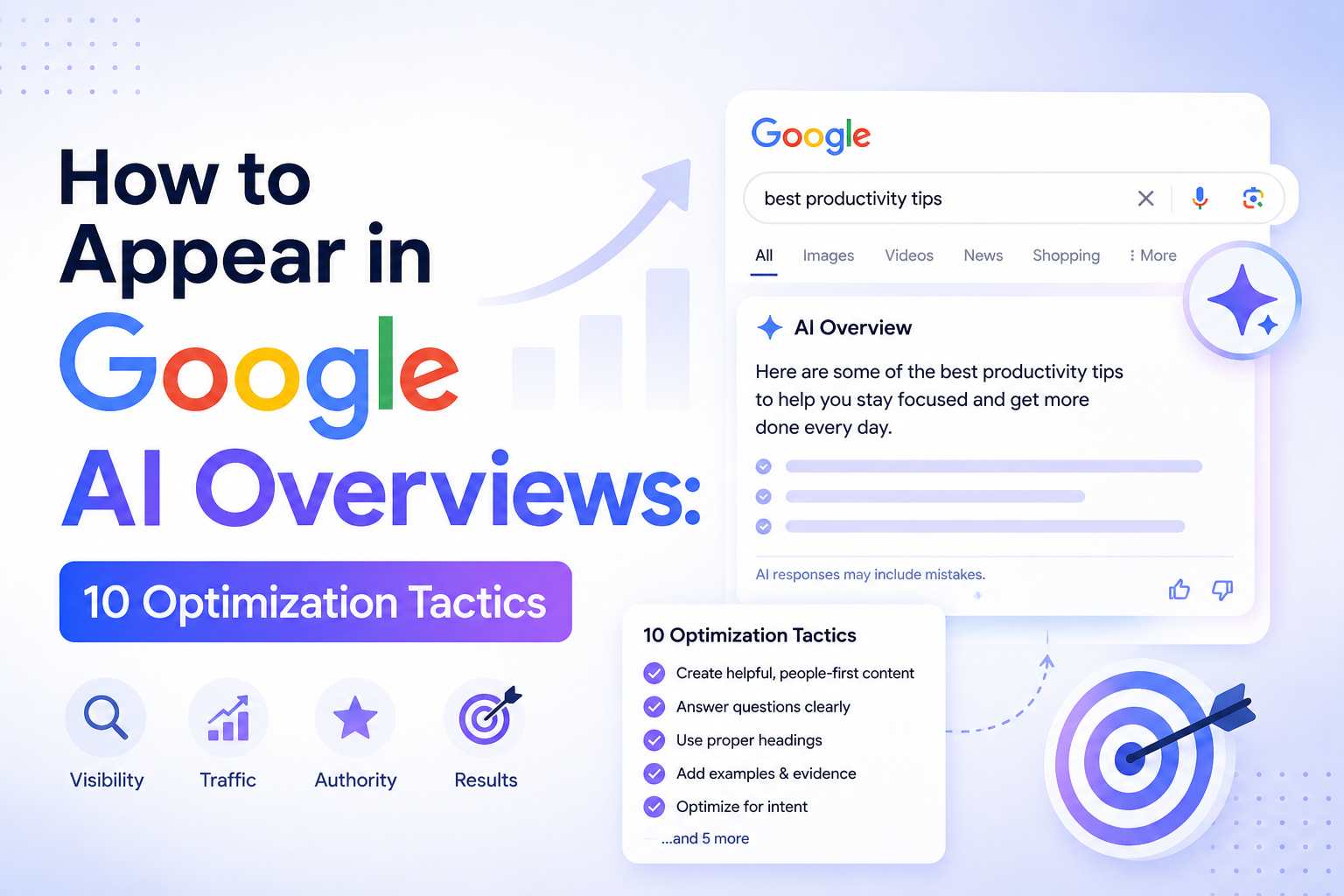
To appear in Google AI Overviews, rank in the top results for the query (most cited pages already rank well), answer the question directly in the first 40–70 words of the relevant section, structure content into self-contained passages with question-based headings, include statistics with credible sources, add FAQ and Article schema, build topical authority with interlinked cluster content, keep pages fresh and crawlable, and strengthen E-E-A-T signals such as named expert authors. Track citations monthly with a fixed prompt set.
Introduction: The New Top of Google
For years, “position one” was the prize in SEO. In 2026, there is something above position one: the AI Overview — a generated answer assembled by Google’s Gemini models that sits at the very top of the results page for a large and growing share of informational and commercial-research queries. It answers the question directly, and it cites a handful of sources in expandable link cards.
Those citation slots are the new prime real estate. Pages cited in an AI Overview gain visibility even when users do not click, and the clicks that do come are from users who saw your brand presented as a trusted source. Pages left out lose visibility even while technically ranking in the classic results below — which now begin further down the page.
The good news: AI Overview citations are not random, and they are not reserved for giant brands. Google builds these answers from retrievable, well-structured, trustworthy content — qualities you can engineer deliberately. In this guide, Webin Marketing breaks down how AI Overviews select sources and the ten tactics that consistently earn citations. This article zooms into Google specifically; for the broader discipline across ChatGPT, Perplexity, and Gemini, read our complete generative engine optimization guide.
How AI Overviews Actually Work
Understanding the machinery tells you exactly where to optimize. When a query triggers an AI Overview, Google’s systems perform what is known as query fan-out: the original question is expanded into multiple related sub-queries, each of which retrieves candidate documents from Google’s regular index. A Gemini model then reads the retrieved passages, synthesises an answer, and attaches citations to the sources that contributed most.
Three practical consequences follow:
- Ranking still gates everything. Studies throughout 2025 consistently found that the majority of AI Overview citations come from pages already ranking in the top organic results for the query or its fan-out variants. Classic SEO is the entry ticket — AI Overviews are built on top of the index, not beside it, as Google describes in its own documentation on AI features in Search.
- Passages are the unit of selection, not pages. The model lifts specific chunks. A page that buries its answer in paragraph nine loses to a page that answers cleanly in paragraph one — even at a lower rank.
- Fan-out rewards breadth. Because one user question becomes many sub-queries, sites that cover a topic’s full question space (the cluster) get multiple chances per Overview to be retrieved.
Which Queries Trigger AI Overviews
Not every search produces one. AI Overviews appear most often on informational queries (how, what, why, can, should), comparison and “best” research queries, health, finance and how-to topics, and long conversational questions. They appear least on navigational queries, hyper-local transactional searches, and queries where Google’s systems have low confidence. Check your own keyword map: every query phrased as a question is now a two-front battle — the classic ranking and the Overview citation — and your content should be built to win both with the same page.
The 10 Tactics That Earn AI Overview Citations
Tactic 1: Rank First, Then Optimize for Citation
Audit which of your target queries trigger AI Overviews and where you currently rank. Pages ranking in the top ten for the query or its close variants are your citation candidates — prioritise them. Pages ranking nowhere need the foundational work first: intent-matched content, on-page optimization, internal links, and authority. Our on-page SEO checklist covers that foundation factor by factor.
Tactic 2: Lead Every Section with the Answer
Apply the inverted pyramid at section level, not just page level. Under each question-based heading, the first one or two sentences should completely answer that heading’s question; elaboration follows. This produces the dense, self-contained passages the retrieval layer prefers, and it is the single highest-impact writing change for AI visibility.
Tactic 3: Write Question-Based Headings That Mirror Fan-Out
Harvest the real sub-questions around your topic — People Also Ask boxes, autocomplete, Reddit threads, and your own customer questions — and make them your H2s and H3s verbatim or near-verbatim. Each heading becomes a retrieval hook for one of the fan-out sub-queries. Twenty well-chosen question headings across a cluster give you twenty chances per Overview.
Tactic 4: Pack Passages with Cited Statistics
The original generative engine optimization research found statistics and citations among the strongest boosters of AI answer visibility. Include specific numbers, dates, and percentages, attribute them to credible sources with links, and refresh them on a schedule. Models preferentially quote passages that look verifiable — vague claims get paraphrased without credit; precise sourced claims get cited.
Tactic 5: Use Lists and Tables for Extractable Structure
AI Overviews frequently render step lists and comparison summaries. Content already formatted as numbered steps, bullet lists, and comparison tables maps directly onto that output shape, making your version the easiest to lift. Convert prose processes into numbered steps; convert prose comparisons into tables.
Tactic 6: Build the Full Topic Cluster
Because fan-out retrieves across many sub-queries, a single great page competes worse than a pillar page surrounded by interlinked supporting articles that each own one sub-question deeply. Map the cluster with proper keyword research, interlink everything with descriptive anchors, and your domain can be retrieved for multiple fan-out branches of the same Overview — multiplying citation probability.
Tactic 7: Implement Schema That Mirrors Your Content
Add Article, FAQPage (where visible FAQs exist), HowTo, and Organization markup, validated with the Rich Results Test. Structured data does not guarantee citation, but it sharpens machine understanding of your entities, questions, and answers — reducing the chance the model misreads or skips your content. Keep markup honest: schema for content not visible on the page violates guidelines.
Tactic 8: Strengthen E-E-A-T Signals
AI Overviews are conservative by design — Google needs its generated answers to be safe, which biases selection toward trustworthy sources. Named expert authors with bio pages, cited claims, transparent about/contact pages, and a clean reputation footprint all raise your selection probability, especially on YMYL-adjacent topics. Our full E-E-A-T playbook details every signal.
Tactic 9: Keep Content Fresh and Technically Retrievable
Refresh statistics and recommendations on cited-candidate pages at least twice yearly with a visible updated date — retrieval favours current content on evolving topics. Technically: server-render important content, keep pages fast, maintain clean sitemaps, and confirm in Search Console that candidate pages are indexed and crawled regularly. A passage that cannot be retrieved cannot be cited, which is why the technical SEO audit precedes everything in this list.
Tactic 10: Measure Citations Systematically
Build a fixed prompt set of 25–50 queries that matter to your business and trigger AI Overviews. Check them monthly (manually or with tracking tools), recording: does an Overview appear, is your brand cited, which page, and which competitors hold the other slots. Pair this with Search Console (AI Overview clicks are folded into normal performance data) and GA4 to watch behaviour shifts. Without measurement, you cannot know which tactics are working — with it, you will see citation wins follow specific page improvements within weeks.
A Worked Example: Rebuilding One Page for Citation
Theory lands better with a before-and-after. Imagine a page titled “Email Marketing Tips” ranking sixth for “how to improve email open rates” — a query that triggers an AI Overview citing three competitors.
Before: a 1,800-word essay opening with two paragraphs on the history of email, a heading structure of clever labels (“The Inbox Battlefield,” “Crafting Magic”), advice scattered through prose, no statistics, no sources, an “admin” byline, and a 2024 publish date.
After the rebuild: the title and H1 become “How to Improve Email Open Rates: 12 Proven Tactics (2026)”. Directly under the H1 sits a 55-word summary answering the query outright. Every H2 becomes a real sub-question harvested from People Also Ask — “What is a good email open rate?”, “Do subject line emojis increase opens?”, “What time should you send emails?” — each answered completely in its first two sentences. Industry benchmark statistics appear with linked sources. The advice consolidates into one numbered 12-step list and one comparison table of send-time studies. A named author with an email-marketing bio replaces “admin,” an updated date reflects a genuine refresh, FAQPage schema mirrors the visible FAQ, and three internal links connect the page to its cluster.
Nothing about the page’s *topic* changed — only its retrievability, liftability, and trustworthiness. In our client work, exactly this pattern of rebuild on an already-ranking page is what converts “present but invisible” into a cited source within one or two crawl-and-refresh cycles. Run the same surgery on your top ten ranking-but-uncited pages before creating anything new.
AI Overview Optimization Checklist
| Element | Standard | Priority |
| Organic ranking | Top 10 for query or variants | Critical |
| Section-level answers | First 1–2 sentences answer the heading | Critical |
| Question headings | Mirror PAA and real user phrasing | Critical |
| Statistics + sources | 3–5 per article, linked, current | High |
| Lists and tables | Steps numbered, comparisons tabled | High |
| Topic cluster | Pillar + interlinked sub-articles | High |
| Schema | Article + FAQPage validated | High |
| E-E-A-T | Named authors, citations, transparency | High |
| Freshness | Visible updates, twice-yearly refresh | Medium |
| Citation tracking | Fixed prompt set, monthly | High |
What Getting Cited Is Worth — Honest Expectations
Citation economics differ from ranking economics. Expect lower click-through rates on queries with Overviews — many users are satisfied by the generated answer — but expect the clicks you receive to be higher intent, and expect brand impressions that classic rankings never delivered: your name presented inside the answer itself. For commercial-research queries (“best CRM for small business India”), a citation effectively functions as a recommendation. The strategic response is not to mourn lost informational clicks but to ensure your money pages and brand capture the demand that Overviews create: clear branding on cited pages, strong internal paths from cited content to conversion pages, and Overview-aware reporting that values impressions and assisted conversions, not clicks alone.
Common Mistakes That Keep Sites Out of AI Overviews
- Optimizing pages that do not rank anywhere for the target query — citation follows retrieval, retrieval follows ranking
- Burying answers under long storytelling introductions
- Headings written as clever labels instead of real questions
- Unsourced claims and stale statistics the model cannot trust
- One mega-page strategy instead of a retrievable cluster
- Blocking Google-Extended or breaking rendering so passages never reach the model
- Checking citations once, seeing nothing, and abandoning the program in week three
Frequently Asked Questions About Google AI Overviews
Do I need to rank #1 to be cited in an AI Overview?
Can I opt out of AI Overviews while staying in search?
Do AI Overviews reduce my traffic?
How long does it take to win a citation?
Is AI Overview optimization different from featured snippet optimization?
Does this work for languages other than English and for India specifically?
Conclusion: Become the Source the Answer Is Built From
AI Overviews did not end SEO — they raised the prize. The page that once won a ranking now competes to become raw material for the answer itself, named and linked at the top of Google. The path there is concrete: rank through fundamentals, restructure into answer-first passages under real question headings, arm every claim with sourced statistics, build the cluster, mark it up, prove your trustworthiness, and measure citations like you once measured rankings.
Webin Marketing builds exactly these programs — combined SEO and AI-visibility strategies with monthly citation tracking — through our SEO services for businesses across India and worldwide. Book a free strategy call and we will show you which of your queries already trigger AI Overviews, who is being cited, and the fastest route to making it you.
Affiliate Disclosure
Some links in this article may be affiliate links. If you purchase a tool or service through these links, Webin Marketing may earn a small commission at no extra cost to you. We only recommend tools we have tested or genuinely believe add value to our readers.
Disclaimer
This article is for informational and educational purposes only. Google’s AI Overview systems evolve rapidly, and no agency can guarantee citations, rankings, or traffic outcomes. Behaviour described here reflects publicly documented and observed patterns at the time of writing; always verify against current official documentation and your own measurement data.