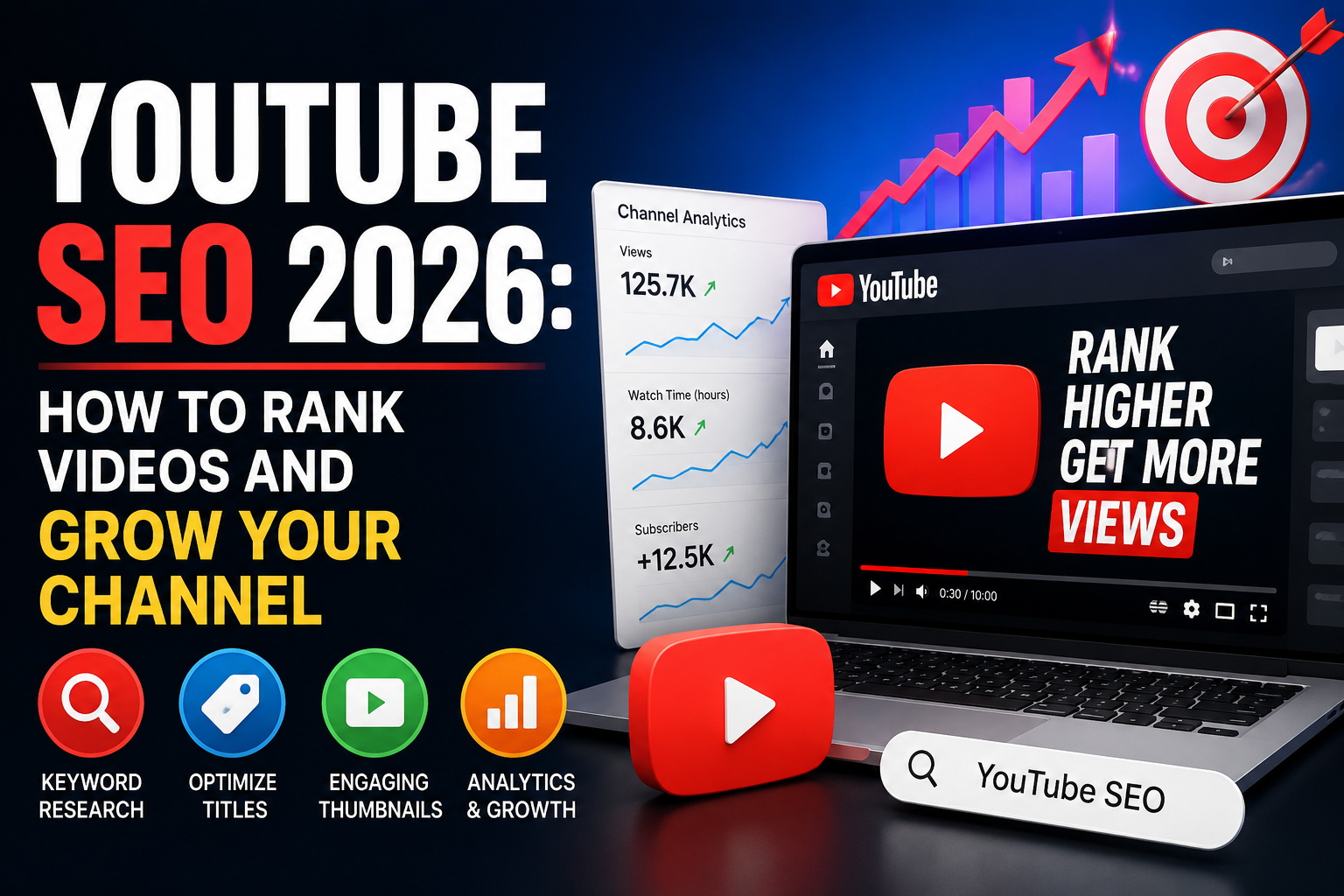
Quick Answer (AI Overview Snippet): YouTube SEO in 2026 means optimizing videos for YouTube’s recommendation systems and Google’s video results: research keywords with YouTube autocomplete and competitor analysis, put the keyword naturally in the title and opening spoken lines, design thumbnails for click-through rate, maximise retention with strong hooks and tight pacing, add accurate descriptions, chapters and subtitles, and build topical playlists. Rankings follow satisfied watch behaviour — CTR and retention outweigh tags and tricks.
Introduction: The Second-Largest Search Engine Has Its Own SEO
YouTube is where a huge share of the world goes to learn, compare, and decide — billions of logged-in users monthly, and in India specifically, the default destination for everything from “how to file GST” to product reviews before purchase. Every one of those informational and commercial journeys begins with a search or a recommendation, and both are algorithmic systems you can optimize for.
Video also feeds your wider search presence: YouTube results appear inside Google’s main results and video tabs, video carousels rank for how-to queries, and AI Overviews increasingly cite and embed videos. A channel built on searchable topics becomes an asset that compounds across YouTube, Google, and AI surfaces simultaneously — while a channel built on guesswork uploads into the void.
This guide from Webin Marketing covers the complete YouTube SEO system for 2026: how the algorithm actually decides, keyword research for video, the optimization checklist per upload, and the channel-level structures that compound. It pairs with our written-content playbooks — the same intent-first thinking from our keyword research guide applies here, with a camera.
How YouTube’s Algorithm Actually Works in 2026
Forget the mythology — YouTube’s systems optimize for one thing: viewer satisfaction, measured through behaviour. Three surfaces matter:
| Surface | What Decides Visibility | Your Levers |
| Search results | Relevance to query + CTR + retention on that query | Keywords in title/description/spoken words, thumbnail, content match |
| Suggested/Home | Predicted satisfaction for each viewer (CTR, watch time, history fit) | Thumbnails, hooks, session-extending content, consistency |
| Shorts feed | Swipe-through vs watched/rewatched %, engagement | First-second hook, loopability, vertical-native content |
Two metrics dominate everything: click-through rate (does your packaging earn the click against competing impressions?) and retention (do clickers stay, signalling the click was deserved?). Metadata gets you considered; behaviour gets you ranked. Every tactic below serves one of those two numbers — and “tag tricks” that serve neither are noise.
Step 1: YouTube Keyword Research
Video keyword research mirrors web research with platform-native sources:
- YouTube autocomplete. Type seed topics and harvest suggestions — these are real video queries, often phrased differently from web searches (“kurta styling for men” vs “men’s kurta ideas”).
- Competitor mining. Sort competing channels’ videos by popularity; their top performers reveal proven demand. Note the exact title phrasing that wins in your niche.
- Google’s video intent check. Search your target keywords on Google: queries showing video carousels or video-heavy results offer double placement — YouTube *and* Google rankings for one upload.
- Comments and community. Questions under popular niche videos are pre-validated topics with guaranteed audiences.
- Trends and seasonality. Google Trends (filtered to YouTube search) catches rising topics early — first-quality-video advantage on a growing query can own it for years.
Map keywords to formats deliberately: searchable evergreen topics (“how to,” “tutorial,” “review,” “vs”) build the long-term ranking library; trend and personality content feeds Suggested. Healthy channels run both lanes on purpose.
Step 2: Optimize Every Upload — The Checklist
Title: Keyword + Click Reason, Under ~60 Characters
Front-load the search phrase naturally, then add the reason to click: a number, an outcome, a tension. “Shopify SEO Tutorial 2026: Rank Your Store in 90 Days” works for both the search system and the human. Never bait beyond what the video delivers — mismatch murders retention, and retention is the ranking.
Thumbnail: The Real Title
Thumbnails decide CTR more than titles do. Principles that survive every trend: one clear focal point, readable at phone size, three or fewer words of overlay text that *complement* (not repeat) the title, faces with emotion where relevant, and consistent channel style so regulars recognise you in the feed. Test alternatives with YouTube’s built-in thumbnail A/B testing — packaging experiments are the highest-ROI hour in video marketing.
The First 30 Seconds: Hook or Die
Retention graphs cliff in the opening seconds. Open by confirming the click’s promise (“By the end of this video you’ll have X”), preview the payoff, and start delivering immediately — no minute-long intros, no logo animations, no “before we start.” Script your hooks even if you script nothing else.
Description: Front-Load, Then Structure
The first two or three lines (visible before “more”) should state the video’s value with the main keyword naturally included. Below the fold: a genuine summary paragraph, timestamps, resource links — including relevant pages on your site, which is how video traffic becomes pipeline — and your channel links. Descriptions are indexed by both YouTube and Google; write them like the mini landing pages they are.
Chapters, Subtitles, and Spoken Keywords
Add timestamped chapters — they improve navigation, surface in search as key moments, and let Google deep-link to the exact answer inside your video. Upload or correct subtitles: YouTube transcribes everything and *indexes what you say*, so speaking your keyword and its variants naturally in the opening lines is on-page SEO with your voice. Accurate captions also expand your audience and feed the multimodal systems deciding which videos AI answers feature.
Tags, Category, End Screens
Tags carry minimal weight now — add a handful for spelling variants and move on. Set the right category, add end screens pointing to your most related video (session time you keep credits you), and pin a comment that drives the next action.
Step 3: Channel-Level SEO — Where Compounding Lives
- Topical focus. Channels about one clear subject train the system on who to recommend them to. The scattered channel confuses the recommender and the audience alike — the video equivalent of the topical authority that powers website clusters.
- Playlists as clusters. Group videos into keyword-titled playlists that mirror search topics; playlists rank themselves, extend sessions, and define your channel’s structure the way pillar pages define a site’s.
- Series and consistency. Recurring formats build returning viewers — the strongest satisfaction signal a channel can send. Sustainable cadence beats sporadic ambition: one good video weekly outgrows four rushed ones monthly.
- Shorts as discovery, long-form as depth. Shorts reach new audiences cheaply; their job is to convert browsers into subscribers who then watch your ranking library. Point every Short at its related long-form video.
- Channel page basics. Keyword-aware channel description, organised home page with playlists, branded banner stating the value proposition, and links to your website — small trust signals that close the loop for both viewers and search systems.
Step 4: Video SEO Beyond YouTube
Your videos can rank twice. Embed each video in the matching article on your site — the post targets the written query, the embed targets the video carousel, and both reinforce each other’s engagement. Add VideoObject structured data on pages with embedded video so Google understands and badges them, per the video best-practice documentation. Transcribe videos into article drafts (one production, two assets), and remember AI Overviews increasingly include video citations for how-to queries — clearly chaptered, well-transcribed tutorials are exactly what gets surfaced, the video face of the generative engine optimization playbook.
A 90-Day Plan for a New or Stalled Channel
Systems beat sporadic effort, so here is the sequence we give clients starting from zero or from a plateau.
Days 1–14: Research and foundation. Build a 30-topic backlog from autocomplete, competitor top-performers, and customer questions — every topic validated by visible search demand. Define one or two repeatable formats you can sustain (tutorial series, review series). Fix the channel page: keyword-aware description, organised layout, banner stating who the channel helps and how.
Days 15–45: The first library. Publish weekly from the backlog, prioritising long-tail searchable topics where small channels rank fastest. Script hooks tightly, chapter everything, correct captions, and end-screen each video to its most related sibling. Resist judging by views — early uploads are training data for both the algorithm and your production process.
Days 46–75: Packaging optimization. Now there is data. A/B test thumbnails on the three highest-retention videos with weak CTR; rewrite titles that underpromise. Launch Shorts cut from your best long-form moments, each pointing home to its source video. Build your first two keyword-titled playlists.
Days 76–90: Double down and integrate. The search-terms report now shows what YouTube thinks you are about — make the two videos it is asking for. Embed your ranking videos into the matching articles on your site with VideoObject schema, closing the loop between channel and website. Review the dashboard: rising returning-viewer counts and a growing search-traffic share are the signals the engine has started compounding.
Ninety days will not make a channel famous; it reliably makes one *legible* — to viewers, to the algorithm, and to the Google surfaces where video now appears. From there, consistency does the rest.
Measuring What Matters in YouTube Studio
| Metric | Where | What It Tells You |
| CTR by video | Reach tab | Packaging strength — test thumbnails below ~4–5% on search-driven videos |
| Retention curve | Engagement tab | Where viewers leave; fix hooks for cliffs at the start, pacing for steady decay |
| Traffic sources | Reach tab | Search vs Suggested vs Shorts mix — confirms which lane each video wins |
| Search terms | Reach → YouTube search | The actual queries finding you; mine them for the next ten topics |
| Returning vs new viewers | Audience tab | Whether formats are building a base or renting one |
| Subscribers per video | Content tab | Which topics convert browsers into audience |
Run the loop monthly: find videos with strong retention but weak CTR (repackage them — new thumbnail and title revive old uploads), videos with strong CTR but cliff retention (fix the hook formula), and search terms you rank #4–#10 for (make the better, more specific video). Optimization on existing videos is the most underused growth lever on the platform — nothing on YouTube is ever finished ranking.
Equipment and Production: The Honest Minimum
A recurring blocker deserves demolishing: you do not need a studio. Rankings come from topic selection, packaging, and retention — none of which a camera upgrade buys. The honest minimum is a modern smartphone, an affordable lavalier or USB microphone (audio quality affects retention far more than video quality), window light or one softbox, and free editing software. Spend your upgrade budget on better hooks, tighter scripts, and thumbnail iteration before any lens. The channels that win search niches are consistently the ones that out-research and out-structure competitors, not the ones that out-spend them — production polish is a multiplier on substance, never a substitute for it.
Common YouTube SEO Mistakes
- Choosing topics by inspiration instead of demonstrated search demand
- Titles written for keywords with thumbnails written as afterthoughts
- Sixty-second intros before any value arrives
- Chasing Shorts virality with no long-form library for converts to land on
- Deleting or privating underperformers instead of repackaging them
- Uploading at random cadence and wondering why returning viewers never form
- Ignoring the search terms report — your audience literally tells you what to make next
Frequently Asked Questions About YouTube SEO
How long does it take to rank a YouTube video?
Do tags still matter for YouTube SEO in 2026?
How important is watch time vs retention percentage?
Can small channels outrank big ones?
Should I optimize old videos or only new ones?
Does YouTube SEO help my website’s SEO?
Conclusion: Make Videos the Algorithm Can Trust
YouTube SEO in 2026 reduces to a clean contract: research what people actually search, package it so they click, deliver so completely that they stay — then give the systems every metadata handle (titles, descriptions, chapters, captions, playlists) to understand and distribute what you made. Channels that honour that contract compound across YouTube search, Suggested, Google, and AI answers at once.
If you want the system built for your business — topic research, optimization workflows, channel architecture, and integration with your website’s SEO — Webin Marketing runs video and social strategy alongside our search services for brands across India and worldwide. Book a free strategy call and we will map the video keywords your competitors haven’t claimed yet.
Affiliate Disclosure
Some links in this article may be affiliate links. If you purchase a tool or service through these links, Webin Marketing may earn a small commission at no extra cost to you. We only recommend tools we have tested or genuinely believe add value to our readers.
Disclaimer
This article is for informational and educational purposes only. YouTube’s and Google’s systems evolve continuously, and no agency can guarantee specific rankings, views, or subscriber outcomes. Results depend on niche, content quality, and consistency; validate tactics against your own analytics.