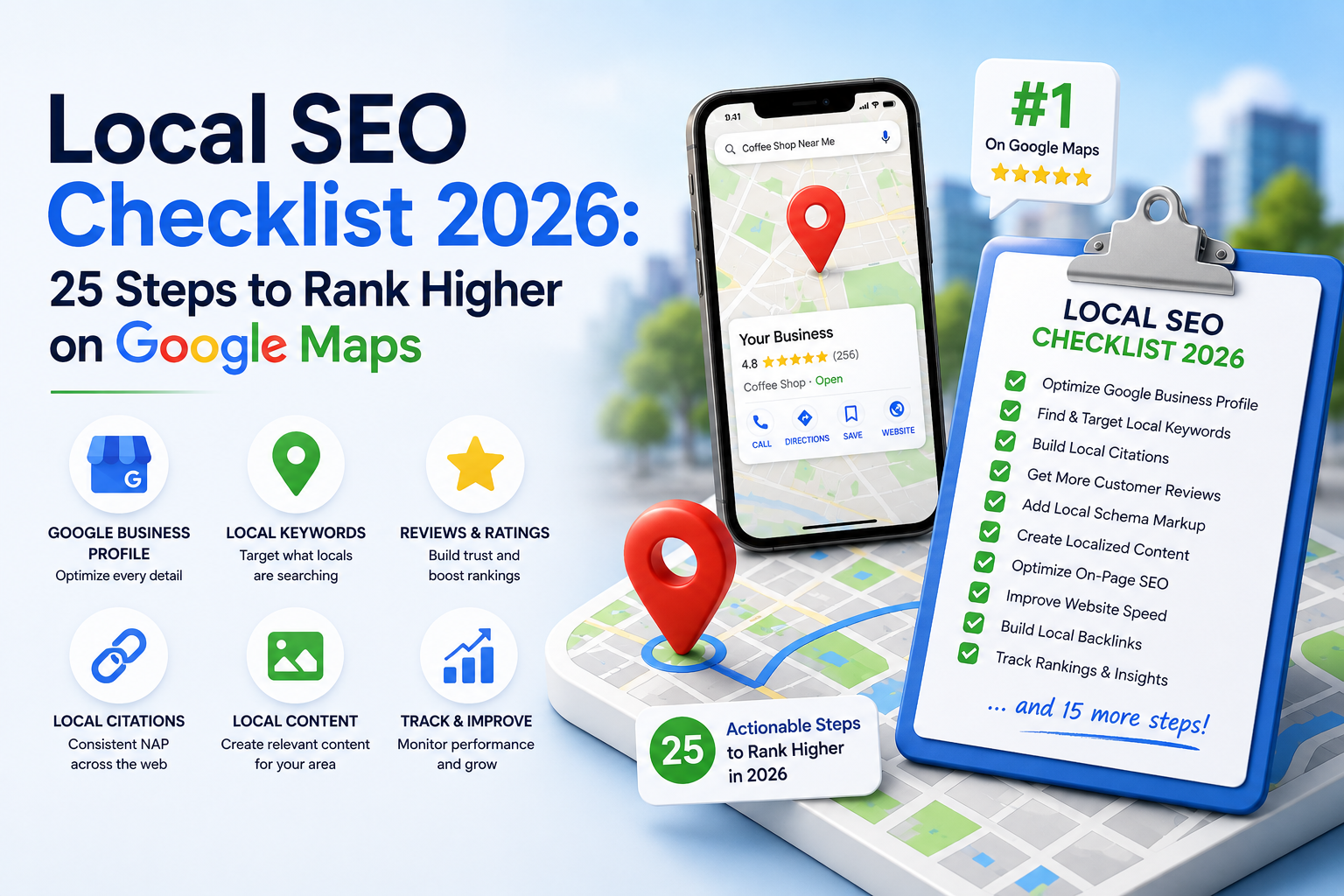
To rank higher on Google Maps in 2026, fully complete and verify your Google Business Profile, choose accurate primary and secondary categories, collect a steady flow of keyword-rich reviews and reply to all of them, build consistent NAP citations across top directories, create location-specific landing pages with local schema markup, and earn links and mentions from local websites. Proximity, relevance, and prominence remain Google’s three core local ranking factors.
Introduction: Why Local SEO Is Your Highest-ROI Channel
When someone searches “coffee shop near me,” “best SEO agency in Ahmedabad,” or “emergency plumber open now,” they are not browsing — they are ready to act. Google reports that a large share of local mobile searches result in a store visit or contact within 24 hours. That intent makes local SEO one of the highest-converting channels available to any business with a physical location or service area.
Yet most local businesses set up a Google Business Profile once, forget it, and wonder why competitors dominate the map pack. The truth is that local rankings in 2026 are won through systematic, ongoing optimization — and with AI Overviews now answering many local queries directly, the businesses with the strongest profiles and review signals get recommended while everyone else becomes invisible.
This checklist from Webin Marketing gives you all 25 steps in priority order. Work through them top to bottom; the first ten alone typically produce visible movement within 60–90 days. If you are completely new to search marketing, start with our beginner guide on what SEO is in digital marketing and return here.
How Google Ranks Local Businesses: The 3 Pillars
Before the checklist, understand what you are optimizing for. Google’s own documentation on improving local ranking names three factors:
| Pillar | What It Means | Your Main Levers |
| Relevance | How well your profile matches the search | Categories, services, description, posts, website content |
| Distance | How close you are to the searcher | Service areas, location pages, accurate address |
| Prominence | How well-known and trusted you are | Reviews, citations, links, mentions, brand searches |
You cannot change where searchers stand, so your job is to maximise relevance and prominence. Every step below feeds one of those two pillars.
Part 1: Google Business Profile Foundation (Steps 1–8)
Step 1: Claim and Verify Your Profile
Claim your listing at Google Business Profile and complete verification (video verification is now the most common method). An unverified profile cannot rank competitively and cannot be fully managed.
Step 2: Nail Your Business Name — Without Stuffing
Use your exact real-world business name. Adding keywords (“Webin Marketing | Best SEO Agency Ahmedabad”) violates Google’s guidelines and risks suspension. Competitors who stuff can be reported; clean profiles win long-term.
Step 3: Choose the Right Primary Category
Your primary category is the single strongest relevance signal you control. Pick the most specific match (“Marketing agency” beats “Consultant”), then add every legitimately applicable secondary category. Review competitor categories in the map pack for ideas.
Step 4: Complete Every Single Field
Hours, phone, website, attributes, opening date, services, products, description — Google rewards completeness. Write a 750-character description that naturally mentions your main service and city in the first sentence.
Step 5: Add Services and Products with Descriptions
List every service with its own description and, where possible, pricing. These fields are indexed and matched against long-tail searches like “shopify seo audit price.”
Step 6: Upload Geo-Relevant Photos Weekly
Profiles with regular fresh photos receive significantly more direction requests and calls. Upload real photos of your team, premises, and work — at least 3–5 per week. Name files descriptively before uploading (seo-agency-ahmedabad-office.jpg).
Step 7: Publish Google Posts Consistently
Use Updates, Offers, and Event posts at least weekly. Posts signal an active business, occupy extra SERP real estate, and let you target seasonal keywords.
Step 8: Enable and Answer Q&A — Before Customers Do
Seed your own Q&A section with the ten questions customers actually ask, and answer them thoroughly. Monitor weekly, because anyone can post answers to your profile.
Part 2: Reviews — Your Prominence Engine (Steps 9–13)
Step 9: Build a Repeatable Review Acquisition System
Velocity and consistency beat occasional bursts. Create a short review link (g.page/yourbusiness/review), add it to invoices, email signatures, WhatsApp follow-ups, and QR codes at your premises. Aim for a steady weekly flow rather than 30 reviews in one month and silence after.
Step 10: Encourage Detail — Never Dictate
Reviews that mention your service and city (“best Shopify SEO service in Ahmedabad”) strengthen relevance. You may ask customers to “mention which service you used,” but never write reviews for them, never incentivise with payment, and never gate negative reviewers away — all are policy violations that risk profile suspension.
Step 11: Reply to Every Review Within 48 Hours
Responses signal active management to both Google and prospects. Thank positive reviewers naturally (a service mention in your reply is fine); respond to negative reviews calmly with a path to resolution. Businesses that respond to reviews are consistently perceived as more trustworthy.
Step 12: Diversify Beyond Google
Collect reviews on industry-relevant platforms too — Justdial and IndiaMART for Indian businesses, Clutch and Trustpilot for agencies, TripAdvisor for hospitality. AI assistants aggregate sentiment across platforms when recommending businesses.
Step 13: Monitor and Report Fake Reviews
Audit your reviews monthly. Report obvious spam or competitor sabotage through the profile dashboard, and document patterns for escalation if needed.
Part 3: Website Local Optimization (Steps 14–19)
Step 14: Create a Dedicated Location/City Page
Build a unique page per location targeting “[service] in [city].” Include your embedded Google Map, NAP details, local testimonials, photos, directions, parking information, and area-specific FAQ. Thin duplicate city pages with swapped city names will not rank — every page needs genuinely local content.
Step 15: Add LocalBusiness Schema Markup
Implement LocalBusiness (or a more specific subtype) structured data with your name, address, phone, hours, geo-coordinates, and review ratings. Validate with the Rich Results Test. Schema helps both Google and AI systems understand your entity — the same principle behind generative engine optimization that we cover across our SEO content hub.
Step 16: Match NAP Exactly Everywhere
Your name, address, and phone must be character-identical on your website footer, contact page, schema, and Google Business Profile. Inconsistency erodes trust signals.
Step 17: Target Local Keywords in Titles and Headers
Include city + service in title tags (“Shopify SEO Services in Ahmedabad | Webin Marketing”), H1s, and naturally through body copy. Cover “near me” intent by ensuring your pages mention neighbourhoods and landmarks you serve.
Step 18: Publish Local Content
Write about local events, client case studies from your city, area guides, and “best of [city]” lists. Local content earns local links and gives AI systems locally-relevant passages to cite.
Step 19: Optimize for Mobile Speed
Most local searches happen on phones. Compress images, use caching, and test with PageSpeed Insights — a slow mobile site bleeds calls and direction taps. Our post on free marketing tools for agencies lists the free performance stack we use.
Part 4: Citations, Links, and Authority (Steps 20–23)
Step 20: Build Core Citations First
Submit consistent NAP details to the top general directories (Justdial, Sulekha, IndiaMART for India; Yelp, BBB, Apple Maps, Bing Places globally) plus your industry’s niche directories. Quality and consistency beat volume.
Step 21: Audit and Fix Existing Citations
Search your phone number and old addresses in quotes to find inconsistent or outdated listings, then correct or remove them. One old address can split your prominence signals.
Step 22: Earn Local Links
Sponsor local events, join your chamber of commerce, partner with complementary local businesses, and pitch local news stories. A handful of genuinely local links moves map rankings more than dozens of generic directory links. Authoritative guides like Moz’s local SEO resources consistently rank local link signals among the top factors.
Step 23: Get Mentioned in “Best of” Lists
Reach out to bloggers and publications that run “best [service] in [city]” roundups. These pages are exactly what AI Overviews and ChatGPT cite when users ask for local recommendations — being on the list puts you in the answer.
Part 5: Measurement and Maintenance (Steps 24–25)
Step 24: Track the Right Metrics Monthly
| Metric | Where to Track | Target Trend |
| Map pack rankings (grid) | Local rank tracker | Improving radius coverage |
| Calls, direction requests, website clicks | GBP performance dashboard | Month-over-month growth |
| Review count and average rating | GBP dashboard | Steady weekly additions, 4.5+ |
| Organic traffic to location pages | GA4 + Search Console | Rising local query impressions |
| Conversions from local traffic | GA4 events | Growing calls/forms/bookings |
Step 25: Maintain a Weekly Routine
Local SEO is a habit, not a project: one post, 3–5 photos, every review answered, Q&A checked, and insights reviewed — 30 minutes a week keeps your profile in the active, trustworthy tier that Google and AI assistants prefer to recommend.
Your 90-Day Local SEO Action Plan
Twenty-five steps can feel overwhelming, so here is the same checklist sequenced into a realistic quarter for a busy business owner:
| Phase | Weeks | Focus | Key Actions |
| Foundation | 1–2 | Profile basics | Verify profile, fix name and categories, complete every field, add services and a keyword-aware description |
| Activation | 3–4 | Content and proof | Upload 20+ real photos, publish first weekly posts, seed Q&A, launch review link to recent customers |
| On-site | 5–8 | Website relevance | Build or rewrite location page, add LocalBusiness schema, align NAP, optimize titles and mobile speed |
| Authority | 9–12 | Prominence | Submit core citations, fix inconsistent old listings, secure two or three genuinely local links, pitch one “best of” list |
| Routine | Ongoing | Maintenance | 30-minute weekly cycle: post, photos, review replies, metric check |
By the end of week 12, you will have completed every high-impact item on this checklist, and — in most niches — you should already see measurable improvement in calls, direction requests, and map-pack visibility. The businesses that fall behind are rarely the ones lacking knowledge; they are the ones lacking a sequence. This plan is the sequence.
One more practical tip: assign ownership. Whether it is you, a team member, or an agency, local SEO succeeds when one named person is responsible for the weekly routine and reports the five core metrics monthly. Shared responsibility quickly becomes no responsibility, and a dormant profile undoes months of momentum within a quarter.
Local SEO Mistakes That Get Businesses Suspended
- Keyword stuffing the business name field
- Using virtual offices or fake addresses to create extra listings
- Buying or incentivising reviews
- Bulk-creating duplicate listings for the same location
- Setting a service area larger than you genuinely serve
Suspensions can take weeks to appeal and cost you every call in the meantime. Build clean — it compounds.
How AI Search Is Changing Local SEO
One more shift deserves its own section before the FAQ. Local queries are increasingly answered by AI Overviews and chat assistants that synthesise an answer instead of just showing a map. When a user asks Gemini or ChatGPT for “a reliable digital marketing agency in Ahmedabad,” the model weighs the same signals this checklist builds — profile completeness, review volume and sentiment, consistent citations, and third-party “best of” mentions — and then *names* two or three businesses in its answer.
This raises the stakes in both directions. The winners are no longer simply listed above competitors; they are explicitly recommended, often with a one-line justification pulled from reviews. The losers are not ranked lower; they are absent from the answer entirely. Practically, this means review keywords (“they handled our Shopify SEO brilliantly”) and roundup-list placements (Step 23) now carry weight beyond the map pack, because they supply the exact language AI systems quote when recommending you. Every step in this checklist therefore does double duty: it improves your traditional map ranking today and your AI recommendation probability tomorrow.
Frequently Asked Questions About Local SEO
How long does local SEO take to work?
Is local SEO free?
What are the top 3 local ranking factors in 2026?
Do Google Posts really affect rankings?
Can I rank in a city where I have no address?
Does local SEO still matter with AI search?
Conclusion: Own Your Map Pack in 2026
Local SEO remains the most direct line between a search and a sale. Complete profile foundations, a relentless review system, genuinely local website content, and consistent citations will put you ahead of the vast majority of competitors who set and forget. Print this checklist, work through one part per week, and you will see the difference in your calls and direction requests within a quarter.
Prefer experts to handle it end-to-end? Webin Marketing’s SEO services include complete local SEO management — profile optimization, review systems, citations, and local content — for businesses across India and worldwide. Book a free strategy call and get a local visibility audit of your business.
Affiliate Disclosure
Some links in this article may be affiliate links. If you purchase a tool or service through these links, Webin Marketing may earn a small commission at no extra cost to you. We only recommend tools we have tested or genuinely believe add value to our readers.
Disclaimer
This article is for informational and educational purposes only. Google’s local ranking systems and policies change frequently, and no agency can guarantee specific map-pack positions or traffic outcomes. Results vary by industry, location, and competition. Always review Google’s current Business Profile guidelines before implementation.