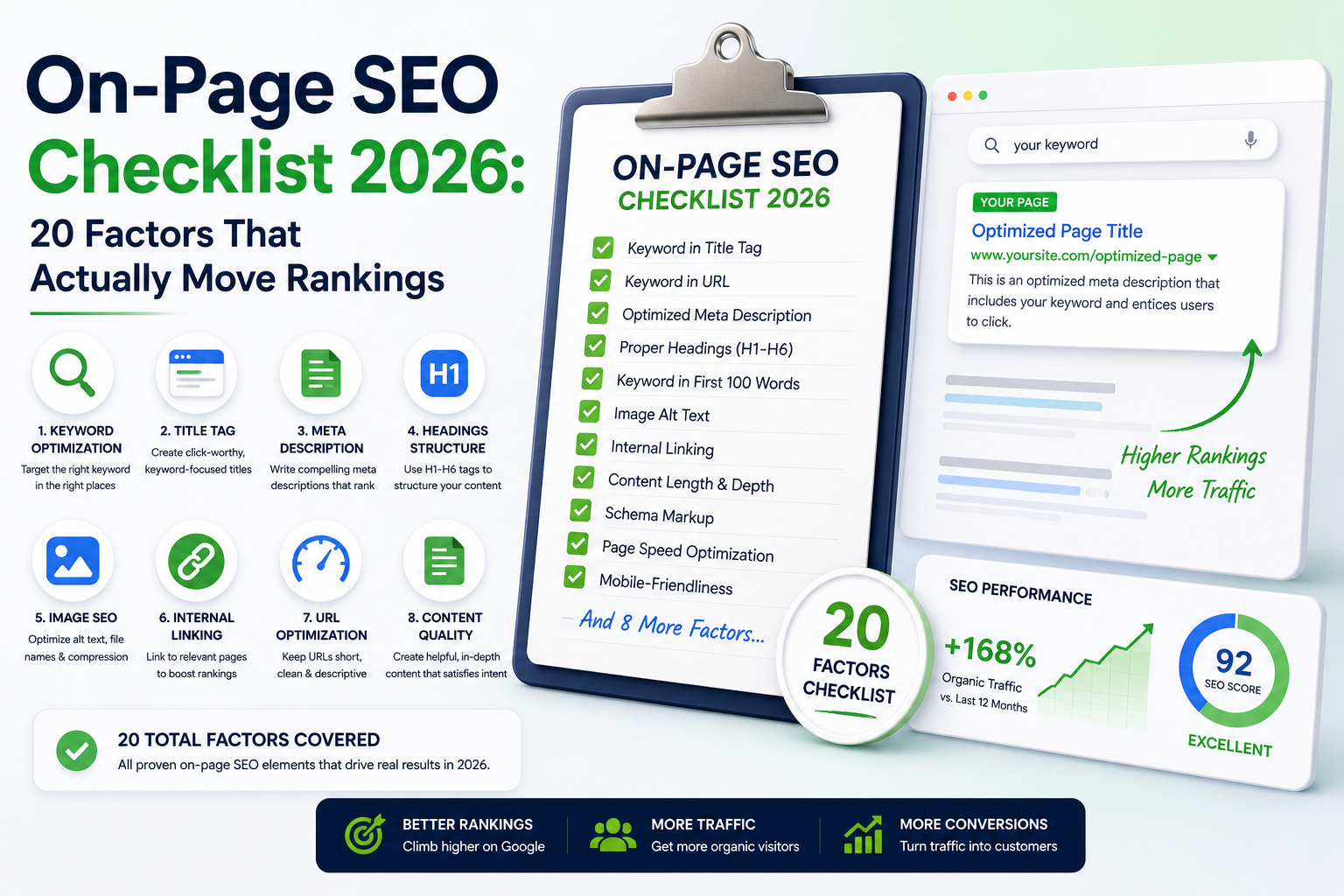
On-page SEO in 2026 means optimizing everything within a page that influences rankings: a keyword-led title tag under 60 characters, a compelling meta description, one clear H1, question-based subheadings, a direct answer in the first 100 words, comprehensive content that satisfies search intent, descriptive URLs, optimized images with alt text, internal links with descriptive anchors, schema markup, fast Core Web Vitals, and visible E-E-A-T signals such as author bios and updated dates.
Introduction: Why On-Page SEO Is Still Your Highest-Leverage Work
Backlinks take months to earn and algorithm updates are outside your control — but everything on your own pages is yours to fix today. That is why on-page SEO remains the highest-leverage work in search marketing: a single afternoon of optimization on an underperforming page regularly produces ranking jumps that would otherwise require months of link building.
The discipline has evolved, though. In 2026, on-page SEO is no longer about hitting a keyword density number. Google’s systems understand topics, entities, and intent — and AI-powered results now lift individual passages straight out of pages to build answers. Modern on-page SEO therefore optimizes for three readers at once: the human visitor, the ranking algorithm, and the language model deciding whether to cite you.
This checklist from Webin Marketing covers all 20 factors in priority order. If you are brand new to search, read our foundational explainer on what SEO is in digital marketing first, then work through this list page by page.
Part 1: The Metadata Layer (Factors 1–4)
1. Title Tag: Your Single Most Important Tag
Keep titles under 60 characters, lead with the primary keyword or place it near the front, and add a differentiator — a year, a number, or a benefit. “On-Page SEO Checklist 2026: 20 Factors That Work” beats “SEO Tips and Tricks for Everyone.” Titles are both a ranking input and your ad copy in the results; a title rewrite alone can lift click-through rate by double digits, which itself feeds back into performance.
2. Meta Description: Write It Like an Ad
Meta descriptions are not a direct ranking factor, but they decide clicks. Write 140–155 characters with the keyword (it gets bolded in results), a concrete benefit, and an implicit call to action. Google rewrites descriptions it dislikes, so the more precisely yours matches the query, the more often it is shown as written.
3. URL Slug: Short, Descriptive, Permanent
Use lowercase, hyphen-separated slugs containing the main keyword: /on-page-seo-checklist-2026/. Avoid dates that force future redirects (year in the slug is acceptable if you commit to updating content annually under the same URL), stop words you do not need, and parameter clutter.
4. One H1 That Matches Intent
Every page needs exactly one H1, normally mirroring or expanding the title tag. The H1 sets the topical promise of the page; everything below should deliver on it.
Part 2: The Content Layer (Factors 5–11)
5. Answer First: The 100-Word Rule
Place a direct, complete answer to the page’s core question within the first 100 words. This wins featured snippets, satisfies impatient readers, and gives AI Overviews a clean passage to lift — the same principle behind generative engine optimization, which we cover in depth in our complete GEO guide.
6. Match Search Intent Precisely
Before writing a word, search your keyword and study the top results. If Google rewards listicles, write a listicle. If it rewards tools pages, a 3,000-word essay will not rank no matter how good it is. Intent match is the gate every other factor passes through.
7. Cover the Topic Completely — Not Just Lengthily
Word count is not a ranking factor; coverage is. Use “People Also Ask,” related searches, and competitor headings to map every sub-question a searcher might have, then answer each one in its own clearly-labelled section. A complete 1,400-word page beats a padded 3,000-word one.
8. Question-Based H2s and H3s
Write subheadings as the real questions users ask: “How long should a title tag be?” rather than “Length considerations.” This mirrors voice and AI query patterns, structures the page for passage retrieval, and makes scanning effortless.
9. Keyword Placement Without Stuffing
Place the primary keyword in the title, H1, first paragraph, at least one H2, and naturally a handful of times through the body. Then stop counting. Use synonyms and related entities the way an expert naturally would — modern systems reward semantic richness, and unnatural repetition reads as low quality to both algorithms and humans.
10. Freshness: Update and Show It
Display a visible “last updated” date and genuinely refresh statistics, screenshots, and recommendations at least annually — more often on fast-moving topics. Updated content consistently recaptures lost rankings, and dated content is increasingly skipped by AI retrieval.
11. Readability and Formatting
Paragraphs of 2–4 lines. Bullet lists for any series of three or more items. Tables for comparisons. Bold for key phrases (sparingly). White space everywhere. Most visitors scan before they read; formatting decides whether they stay long enough to convert.
Part 3: The Media and Link Layer (Factors 12–15)
12. Image Optimization
Compress every image (WebP format), name files descriptively before upload (on-page-seo-checklist-2026.webp), and write alt text that genuinely describes the image. Images feed Google Images traffic, accessibility, and page speed simultaneously.
13. Internal Links With Descriptive Anchors
Every important page should receive internal links from related content using anchors that describe the destination (“local SEO checklist” rather than “click here”). Internal links distribute authority, define your site’s topical structure, and guide crawlers to money pages — see how we interlink our own local SEO checklist and SEO cluster.
14. External Links to Authoritative Sources
Linking out to credible primary sources — official documentation like Google Search Central, research, and respected industry publications — supports your claims and correlates with trustworthiness. Two to four quality external links per article is a healthy norm.
15. Fix Broken Links and Redirect Chains
Broken internal links waste crawl budget and authority; redirect chains slow everything down. Crawl your site quarterly with a free tool and clean up — our roundup of free digital marketing tools lists the crawler we use.
Part 4: The Technical and Trust Layer (Factors 16–20)
16. Schema Markup
Add Article, FAQPage, HowTo, Breadcrumb, and Organization schema where relevant, and validate with the Rich Results Test. Structured data drives rich results and helps machines — including AI assistants — understand your entities and claims.
17. Core Web Vitals and Mobile Experience
Pass LCP, INP, and CLS on mobile. Compress, cache, lazy-load below-the-fold media, and audit third-party scripts. Page experience will not rescue thin content, but slow pages drag down everything else you do.
18. E-E-A-T Signals on the Page
Add an author byline with credentials, an author bio linking to a profile page, citations for claims, and clear contact and about information site-wide. Experience, Expertise, Authoritativeness, and Trust are evaluated from exactly these visible signals.
19. Eliminate Intrusive Interstitials
Aggressive popups that block content on entry hurt both rankings and conversions, especially on mobile. Use exit intent, scroll-based triggers, or inline offers instead.
20. One Page, One Primary Intent
Audit for keyword cannibalisation: when two of your pages target the same query, they split signals and often both underperform. Consolidate, redirect, or differentiate.
The Complete On-Page SEO Checklist Table
| # | Factor | Standard to Hit | Priority |
| 1 | Title tag | <60 chars, keyword-led, differentiated | Critical |
| 2 | Meta description | 140–155 chars, keyword + CTA | High |
| 3 | URL slug | Short, hyphenated, keyword | High |
| 4 | H1 | Exactly one, intent-matched | Critical |
| 5 | First 100 words | Direct answer present | Critical |
| 6 | Search intent | Page type matches SERP | Critical |
| 7 | Topic coverage | All sub-questions answered | Critical |
| 8 | Subheadings | Question-based H2/H3 | High |
| 9 | Keyword placement | Title, H1, intro, 1 H2, natural body use | High |
| 10 | Freshness | Visible update date, annual refresh | High |
| 11 | Formatting | Short paragraphs, lists, tables | High |
| 12 | Images | WebP, named files, alt text | Medium |
| 13 | Internal links | 3–6 in, descriptive anchors | High |
| 14 | External links | 2–4 authoritative sources | Medium |
| 15 | Link hygiene | No broken links or chains | Medium |
| 16 | Schema | Article + FAQ validated | High |
| 17 | Core Web Vitals | All green on mobile | High |
| 18 | E-E-A-T | Author bio, citations, about page | High |
| 19 | Interstitials | No entry-blocking popups | Medium |
| 20 | Cannibalisation | One page per intent | High |
How to Run an On-Page Audit in 60 Minutes
- Pull your 10 highest-impression, lowest-CTR pages from Search Console.
- Rewrite titles and meta descriptions for those pages first — fastest wins available.
- Check each page against factors 5–8: answer-first, intent match, coverage, headings.
- Add or fix internal links pointing into each page from your three most related articles.
- Validate schema and run PageSpeed Insights; log any red Core Web Vitals.
- Note cannibalisation conflicts and schedule consolidations.
- Re-check Search Console in 14–28 days and iterate on what moved.
Keep a simple log — URL, change made, date, result — because over a year that log becomes your own private dataset of what moves rankings in your niche, worth more than any generic study. Repeat this loop monthly across different page sets. On-page SEO compounds precisely because most competitors audit once and never return.
Applying the Checklist by Page Type
The 20 factors apply everywhere, but emphasis shifts by template:
Blog posts and guides. Lead with factors 5–8 (answer-first, intent, coverage, question headings), then internal links into your money pages. Articles are also your AI-citation surface, so the quick-answer block and statistics-with-sources matter disproportionately here.
Service pages. Intent here is transactional, so coverage means objection handling: pricing context, process, proof, FAQs. Add LocalBusiness or Service schema, testimonials with names, and internal links *in* from every related article — service pages rarely earn external links, so internal routing is their oxygen.
Ecommerce collections and products. Unique descriptive copy on collections, unique product descriptions, Product and Review schema, and ruthless cannibalisation control across similar products. The duplication factors (3, 20) and image factors (12) dominate ecommerce outcomes — we expand the full commerce workflow in our Shopify SEO guide.
Homepages. One job: clarify what you do, for whom, where — in the title, H1, and first screen — then route authority outward through clean navigation and contextual links. Homepages targeting nothing rank for nothing.
Measuring On-Page Wins Properly
After any optimization pass, annotate the date and watch three Search Console views for the affected URLs over the next 28 days: average position for the target query, click-through rate at stable positions (titles and metas working), and the count of distinct queries per page (coverage working). Movement usually appears within two to four weeks for recrawled pages; request indexing on changed URLs to accelerate. Treat each monthly audit loop as an experiment with a measured result, and your on-page program improves itself with every cycle — the compounding habit that separates teams who rank from teams who publish.
Common On-Page SEO Mistakes in 2026
- Writing titles for keywords but not clicks (or the reverse)
- Burying the answer under a 400-word storytelling intro
- Publishing without checking what page type the SERP rewards
- Using five H1s because the theme styles them nicely
- Treating internal linking as an afterthought instead of architecture
- Stuffing FAQ schema onto pages with no visible FAQ content
- Refreshing the date without refreshing the content — Google notices
Frequently Asked Questions About On-Page SEO
What is the most important on-page SEO factor?
How many keywords should one page target?
Does keyword density still matter in 2026?
How often should I update old content?
Is on-page SEO enough to rank without backlinks?
How is on-page SEO different for AI search?
Conclusion: Control What You Can Control
Algorithms shift and competitors spend, but your own pages remain fully within your power. Work this 20-factor checklist across your most valuable pages — metadata first, then content, links, and trust signals — and you will steadily out-optimize the majority of sites in any niche, because the majority never do this work systematically.
Want it done for you? The SEO services team at Webin Marketing runs complete on-page audits and implementations for businesses across India and worldwide, with transparent monthly reporting. Book a free strategy call and we will show you the exact pages where an afternoon of on-page work will move the needle.
Affiliate Disclosure
Some links in this article may be affiliate links. If you purchase a tool or service through these links, Webin Marketing may earn a small commission at no extra cost to you. We only recommend tools we have tested or genuinely believe add value to our readers.
Disclaimer
This article is for informational and educational purposes only. Search engine algorithms and guidelines change frequently, and no agency can guarantee specific rankings or traffic outcomes. Results vary based on industry, competition, and implementation. Always consult current official documentation before making significant changes to your website.