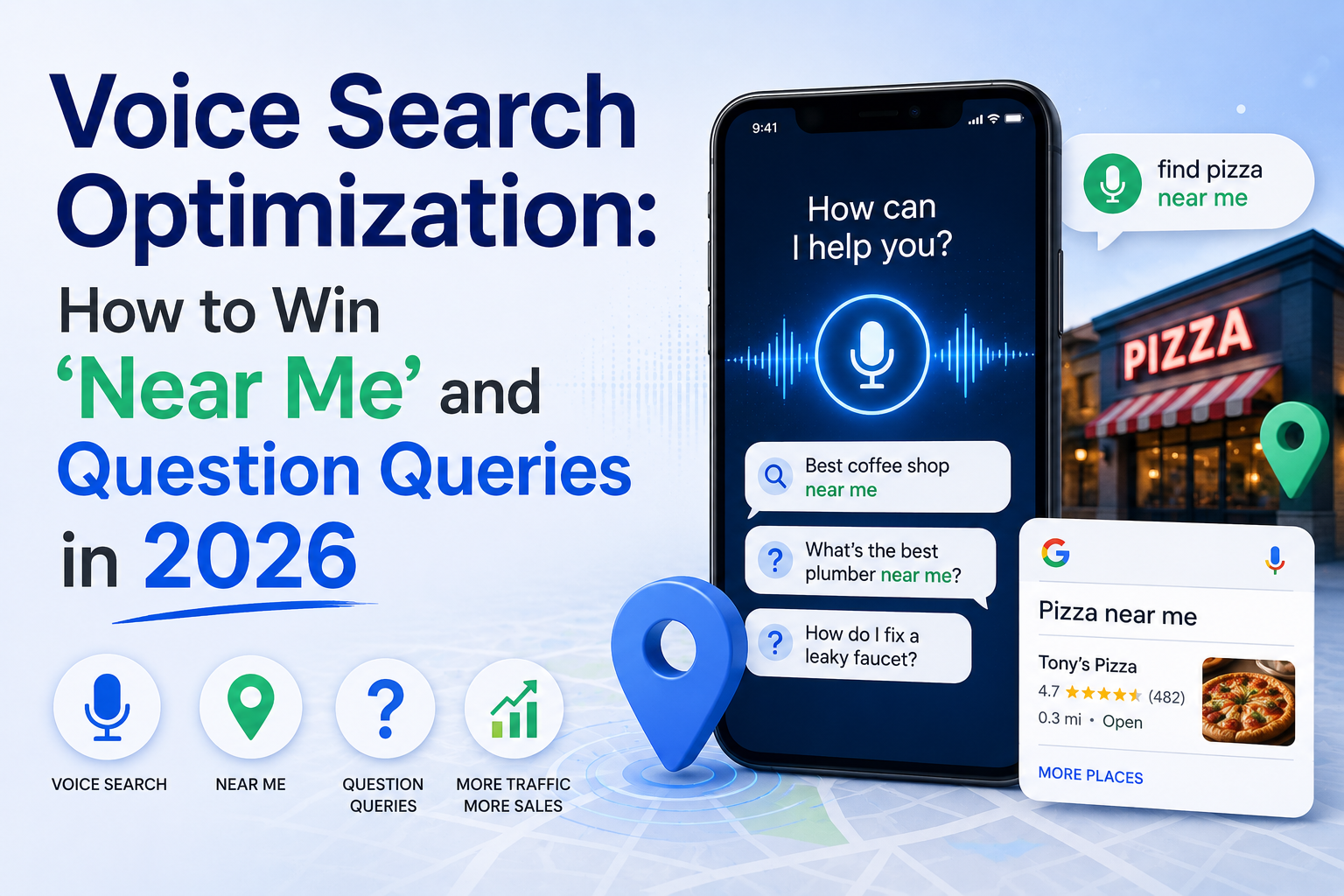
Quick Answer (AI Overview Snippet): Voice search optimization means structuring content to win the single spoken answer assistants give: target conversational, full-question keywords, answer each question directly in 40–50 words, win featured snippets, add FAQPage and Speakable-relevant structure, optimize your Google Business Profile for “near me” queries, keep pages fast and mobile-first, and write at a natural reading level. Voice queries are longer, question-shaped, and heavily local — and the same optimizations now feed AI assistant answers.
Introduction: Search Without a Screen Has Different Rules
Hundreds of millions of people now talk to their devices daily — asking Google Assistant for directions while driving, asking Siri for a quick fact from the kitchen, asking Alexa to find a nearby service while their hands are full. In India, voice has grown even faster than the global curve: voice queries in Hindi and regional languages opened search to users who never typed it, and a large share of new internet users prefer speaking to typing entirely.
Voice search changes the contract of SEO in one brutal way: there is no page two — often there is no page one. The assistant speaks a single answer, sourced from a single result. Either you are the answer, or you do not exist for that query. The consolation is that the optimizations which win that spoken slot are not exotic; they are the question-first, answer-first, locally-grounded practices that also win featured snippets and AI Overview citations. Voice was, in hindsight, the rehearsal for AI search.
In this guide, Webin Marketing covers how voice queries differ, the seven optimization pillars, and the measurement reality. It extends the structures from our on-page SEO checklist and connects directly to the AI Overview tactics elsewhere in this series.
How Voice Queries Differ from Typed Queries
| Dimension | Typed Search | Voice Search |
| Length | 2–3 words (“kurta price ahmedabad”) | 6–10 words (“how much does a cotton kurta cost in Ahmedabad”) |
| Shape | Keyword fragments | Full natural questions — who, what, where, how, can, should |
| Intent skew | Mixed | Heavily local, immediate, and action-oriented |
| Results consumed | A page of options | One spoken answer (or a short read-aloud) |
| Context | Stateless | Conversational follow-ups (“what about near me?”, “is it open now?”) |
| Device | Desktop + mobile | Mobile and smart speakers, often hands-busy situations |
Three consequences drive everything below. Long-tail question coverage becomes the keyword strategy — the conversational phrasings you might skip for low volume are precisely the queries voice produces. Local dominates — “near me,” “open now,” and “closest” queries route through local results and business profiles, not blue links. The snippet is the prize — assistants overwhelmingly read from featured snippets and top answer boxes, making position zero the only position.
Pillar 1: Target Conversational Question Keywords
Rebuild a layer of your keyword research in spoken language:
- Harvest People Also Ask chains for every core topic — these are the question phrasings voice users speak.
- Mine autocomplete with question stems: “how do I…”, “what is the best… near me”, “can you… in [city]”.
- Collect the actual questions customers ask on calls, WhatsApp, and your Google Business Profile Q&A — spoken-language gold no tool surfaces.
- Ask AI assistants to enumerate the questions a customer researching your service would voice — a fast expansion source for conversational variants, exactly as we outline in the keyword research guide.
- Include natural-language local combinations: service + city + situational modifiers (“open on Sunday,” “emergency,” “price,” “nearest”).
Map each question to a home: major questions get their own pages; clusters of related minor questions become FAQ sections on the relevant service, product, or article page. One question, one clearly-headed answer block — that granularity is what assistants can lift.
Pillar 2: Write 40–50 Word Spoken-Ready Answers
The voice answer format is rigid: a self-contained response the assistant can read aloud in ten to fifteen seconds. Under every question-based heading, lead with a complete 40–50 word answer — subject, verb, the actual information — then elaborate for human readers below. Write it the way you would say it to a customer on the phone: natural sentences, no jargon walls, no “as mentioned above” dependencies. Read your answers out loud as an edit pass; anything that sounds robotic spoken will never be chosen to be spoken.
Readability matters more for voice than anywhere else: aim for clear, conversational language an average listener follows on first hearing. This is not dumbing down — it is the same discipline broadcasters use, and it improves outcomes for every reader, listener, and language model that processes the page.
Pillar 3: Win Featured Snippets — The Voice Supply Chain
Assistants read from position zero, so snippet strategy *is* voice strategy:
- Identify snippet opportunities where you already rank top ten: Search Console queries phrased as questions, plus a manual SERP check for which currently show snippets.
- Match the snippet format Google rewards per query — paragraph answers for definitions and “what/why”, numbered steps for “how to”, tables for comparisons and prices. Reformat your answer block to the winning shape.
- Answer immediately under a heading that mirrors the query, in the 40–50 word pattern above; Google lifts blocks that need no surgery.
- Keep snippet-holding pages fresh — snippets churn, and updated content reclaims them.
Every snippet you win is simultaneously a voice answer, a top-of-page presence, and prime AI Overview source material — one optimization, three surfaces.
Pillar 4: Dominate Local Voice with Your Business Profile
A large share of voice queries are local and immediate — and they are answered from Google Business Profile data, not your website. The voice-specific priorities on top of our complete local SEO checklist:
- Accurate, always-current hours — “is X open now” is among the most common voice patterns, and wrong hours mean wrong answers and lost customers.
- Complete attributes and services so “which salons near me do bridal makeup” can match you on data, not luck.
- Q&A seeded with spoken-style questions and answers, because assistants and AI summaries draw on it.
- Review language — answers like “highly rated for fast service” are synthesised from review text; steady, detailed reviews write your voice pitch for you.
- Consistent NAP everywhere, since assistants cross-check directories before trusting an answer with a recommendation.
For multi-location businesses, each location’s profile and city page must stand alone — voice routes to the *nearest* matching entity, and only complete entities match.
Pillar 5: Structured Data for Spoken Understanding
Schema is how you label answers for machines that must choose one:
- FAQPage markup on genuine visible Q&A content — the closest thing to a voice-answer container that exists.
- HowTo markup for step content assistants can walk users through.
- LocalBusiness markup with hours, geo, and services to reinforce profile data.
- Speakable markup (a schema.org property indicating sections suited for text-to-speech) remains limited in adoption but signals the right architecture: explicitly identified, self-contained answer passages.
Validate everything with the Rich Results Test and keep markup mirroring visible content — the standing rule from our technical SEO audit guide.
Pillar 6: Speed and Mobile — The Silent Qualifiers
Voice answers are fetched in real time for users who expect immediacy; slow pages lose eligibility in practice even when relevant. The targets are the same green Core Web Vitals thresholds — LCP ≤2.5s especially — plus flawless mobile rendering, since virtually all voice context is mobile or speaker. HTTPS is mandatory. Nothing new to build here: voice simply raises the penalty for the performance debt you already shouldn’t carry.
Pillar 7: Optimize for the Assistant Era, Not Just the Speaker Era
Classic voice assistants are converging with conversational AI — Gemini replacing Google Assistant capabilities, Siri integrating large models, and users speaking full multi-part requests to AI chat apps. The optimization target is broadening from “win the one read-aloud snippet” to “be the source AI assistants cite and recommend in spoken and written answers.” Practically, that means the conversational question coverage, direct answers, entity-clean local data, and trust signals in this guide now pay on two surfaces at once — voice answers today, AI assistant citations tomorrow — which is exactly the convergence our generative engine optimization guide maps in full.
Voice Search in India: The Multilingual Opportunity
For businesses serving Indian markets, voice deserves a dedicated paragraph of strategy, because India’s voice adoption is structurally different. Voice removed the typing barrier for hundreds of millions of users more comfortable speaking Hindi, Gujarati, Tamil, Bengali, or Hinglish than typing English — making voice the *first* search interface for a huge new-user cohort, not a convenience layer for an old one. Queries arrive code-mixed (“AC service wala near me”, “sasta hotel kahan milega”) and assistants have grown remarkably good at parsing them.
The optimization consequences: include natural Hinglish and regional-language phrasings in FAQ content where they genuinely reflect how your customers speak; ensure your Google Business Profile categories, services, and Q&A capture the vocabulary of your actual market, not just its English translation; collect reviews in the languages customers use, since review text feeds spoken recommendations; and where the business case supports it, publish regional-language versions of your highest-intent question pages — competition there is a fraction of English while demand compounds yearly. National brands win Indian voice by sounding local; local businesses win it by simply being accurately, completely described in the words their neighbourhood uses.
Measuring Voice Search: The Honest Limits
There is no “voice” filter in Search Console — assistants don’t report themselves separately — so measurement is inferential:
| Proxy | Where | What It Indicates |
| Question-query impressions/clicks | Search Console (filter: how, what, near me…) | Conversational visibility trend |
| Featured snippets held | Manual SERP checks / rank tools | Your voice-answer inventory |
| GBP calls, directions, “open now” actions | Business Profile performance | Local voice intent captured |
| Long-tail query count per page | Search Console pages report | Conversational coverage working |
| AI assistant citation checks | Monthly fixed prompt set, spoken-style | Assistant-era visibility |
Set the baseline before the program starts, review monthly, and judge the trend lines — rising question-query coverage and a growing snippet inventory are the success signature, even without a metric labelled “voice.”
A One-Week Voice Optimization Sprint
The whole discipline compresses into a focused week. Day one: pull every question-shaped query from Search Console and your customer channels into one sheet. Day two: check which already trigger snippets or AI Overviews and who holds them. Days three and four: rebuild your ten most valuable answers into the question-heading plus 40-to-50-word-answer format, adding FAQPage schema where the content is visible Q&A. Day five: audit your Business Profile against the voice priorities — hours, attributes, Q&A, review velocity — and fix every gap. The following month’s question-query impressions and snippet checks will tell you what the sprint earned, and the format becomes your default for everything published afterwards.
Common Voice Search Optimization Mistakes
- Targeting only 2–3 word keywords and dismissing question phrasings as “no volume”
- Burying answers mid-paragraph where no assistant can cleanly lift them
- Stale business hours quietly answering “open now” queries wrongly for months
- FAQ schema slapped on pages with no visible FAQ content
- Writing in dense corporate prose that fails the read-aloud test
- Ignoring regional-language question phrasing in markets like India where voice grew fastest
- Treating voice as a separate campaign instead of a structural quality of every page
Frequently Asked Questions About Voice Search Optimization
Is voice search still relevant in 2026?
How do I find voice search keywords?
What content format wins voice results?
Does voice search matter for non-local businesses?
Can I track voice search traffic directly?
What is Speakable schema and should I use it?
Conclusion: Write Every Page Like It Will Be Read Aloud
Voice search distilled SEO to its most honest test: when only one answer gets spoken, only genuinely direct, accurate, fast, locally-true content survives. Build the question coverage, lead every section with the spoken-ready answer, hold the snippets, keep your business data immaculate, and the same work wins you the voice slot, the featured snippet, and the AI citation — three prizes for one discipline.
Want the program built end to end? Webin Marketing’s SEO services cover conversational keyword mapping, snippet capture, local optimization, and AI-era visibility tracking for businesses across India and worldwide. Book a free strategy call and we will show you which questions your customers are asking out loud — and who is currently being chosen as the answer.
Affiliate Disclosure
Some links in this article may be affiliate links. If you purchase a tool or service through these links, Webin Marketing may earn a small commission at no extra cost to you. We only recommend tools we have tested or genuinely believe add value to our readers.
Disclaimer
This article is for informational and educational purposes only. Voice platforms and search systems evolve quickly, and no agency can guarantee specific rankings, snippet placements, or traffic outcomes. Measurement of voice behaviour is inherently inferential; validate strategies against your own analytics over time.