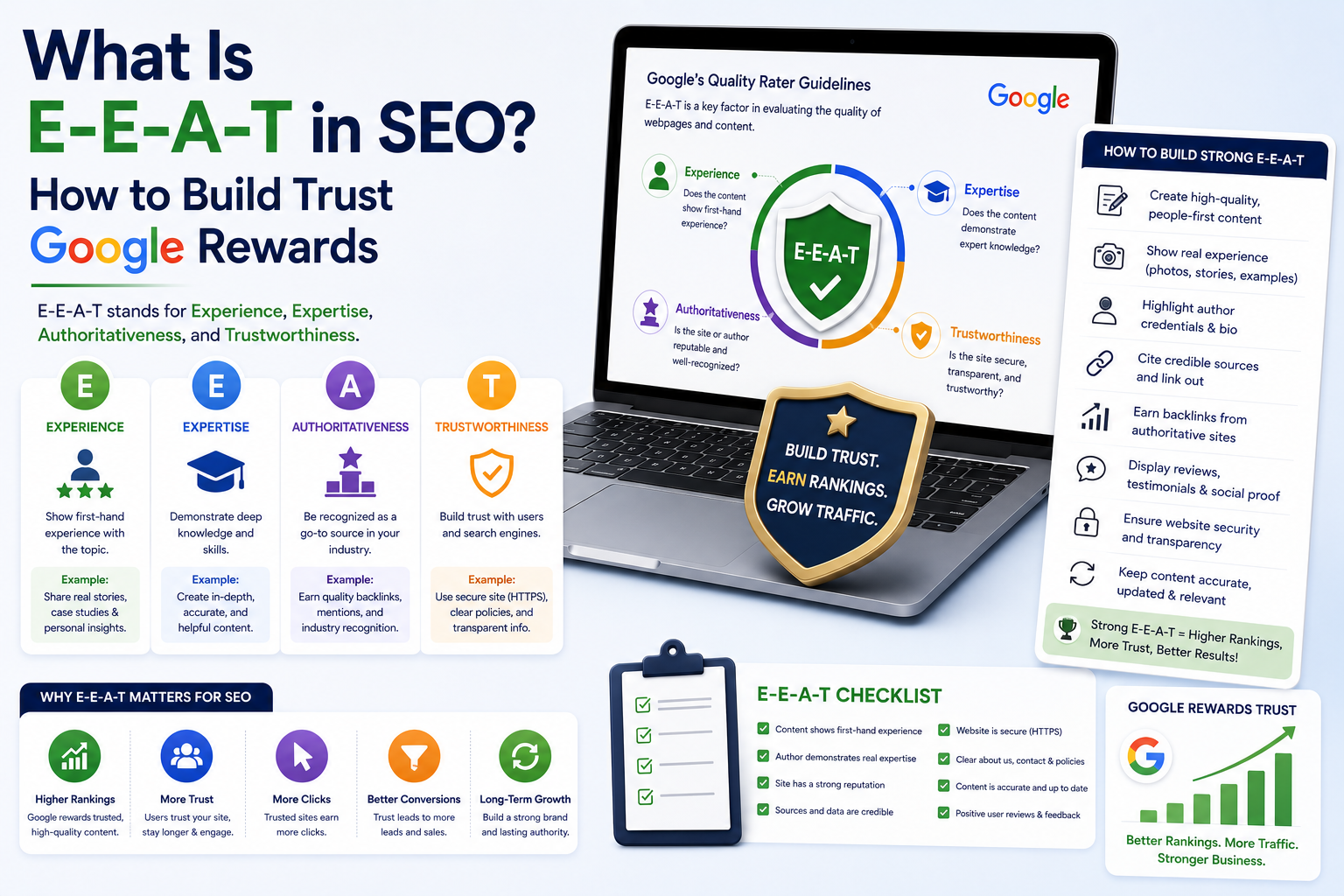
E-E-A-T stands for Experience, Expertise, Authoritativeness, and Trustworthiness — the framework from Google’s Search Quality Rater Guidelines for evaluating content and creator credibility. E-E-A-T is not a single ranking factor but a set of qualities Google’s systems approximate through signals like author credentials, first-hand experience in content, citations, third-party mentions, reviews, and site transparency. It matters most for YMYL (Your Money or Your Life) topics such as health, finance, and safety.
Introduction: Why Google Cares Who Wrote Your Content
Two articles cover the same topic with similar keywords and similar length. One ranks on page one for years; the other never escapes page four. Increasingly, the difference is not on the page at all — it is *who* is behind the page, what experience they demonstrate, and whether the wider web treats them as credible.
That difference has a name: E-E-A-T — Experience, Expertise, Authoritativeness, and Trustworthiness. Originally a framework in Google’s Search Quality Rater Guidelines, it has become the organizing principle behind how modern search evaluates content quality, especially after the rise of mass-produced AI content made credibility the scarcest resource in publishing. And the same credibility signals now decide something newer: whether AI assistants cite your brand when generating answers.
In this guide, Webin Marketing explains exactly what each letter means, how Google actually uses E-E-A-T (and the myths around it), and ten concrete actions to strengthen it on any website. It pairs naturally with our on-page SEO checklist, where trust signals appear as factor 18 — this article is that factor, expanded into a complete playbook.
What E-E-A-T Stands For
Experience: Have You Actually Done This?
The newest E, added in December 2022. Experience asks whether the content creator has first-hand, lived involvement with the topic: actually used the product, visited the place, run the campaign, treated the patients. Experience is what separates a genuine review containing original photos, specific measurements, and discovered flaws from a spec-sheet rewrite — and it is precisely what generic AI-generated content cannot fake.
Expertise: Do You Have the Knowledge?
Expertise is depth of skill or knowledge in the topic, demonstrated either through formal credentials (a doctor writing about medicine) or proven everyday expertise (a mechanic of twenty years writing about engines, a marketer publishing campaign results). Expertise lives at the *creator* level and shows through accuracy, depth, nuance, and the kind of details only practitioners know.
Authoritativeness: Do Others Vouch for You?
Authority is reputation — the extent to which other credible sources treat you or your site as a go-to reference. It is built externally: citations, links from respected publications, media quotes, conference invitations, and being the answer people give when asked “who should I read on this?” You cannot declare authority; the web confers it.
Trustworthiness: Can Users Rely on This Page and Site?
Trust is the most important member of the family — Google’s guidelines state plainly that untrustworthy pages have low E-E-A-T no matter how experienced or expert the author. Trust spans accuracy (claims are correct and sourced), transparency (who runs the site, how to contact them, how content is produced), safety (HTTPS, honest commerce practices), and integrity (clear ads, disclosed affiliations, real reviews).
How Google Actually Uses E-E-A-T (Facts vs Myths)
| Claim | Reality |
| “E-E-A-T is a direct ranking factor with a score” | Myth. It is a quality framework; Google’s systems use many signals that *approximate* E-E-A-T |
| “Quality raters directly change my rankings” | Myth. Raters evaluate search results to benchmark and train systems; they do not demote individual sites |
| “E-E-A-T only matters for health and finance sites” | Partly myth. It matters most for YMYL topics but influences quality assessment everywhere |
| “Adding an author box instantly boosts rankings” | Myth as stated. Visible signals matter as part of a genuine credibility footprint, not as decoration |
| “Links and mentions feed E-E-A-T” | True. Google has confirmed reputation across the web is central to how authority is assessed |
| “AI content automatically fails E-E-A-T” | Myth. Google evaluates quality regardless of production method — but unedited generic AI output typically lacks experience and accuracy |
The practical takeaway: you optimize E-E-A-T by building *real* credibility and then making it *visible and verifiable* — on your pages, in your structured data, and across the web. Google’s own guidance on creating helpful content frames the self-assessment questions worth asking of every page.
YMYL: Where E-E-A-T Becomes Decisive
YMYL — Your Money or Your Life — covers topics where bad information can harm health, finances, safety, or wellbeing: medical advice, investments, legal guidance, news, civic information. For YMYL queries, Google’s systems weight credibility signals far more heavily; anonymous content competing in these niches faces a structural disadvantage no amount of keyword optimization overcomes. If you publish in a YMYL-adjacent niche (including financial-adjacent areas like ecommerce advice and business services), treat every recommendation below as mandatory rather than optional.
10 Ways to Build E-E-A-T on Your Website
1. Create Real Author Pages
Every content author needs a bio page: full name, photo, credentials, experience, links to social profiles and external publications, and a list of their articles. Bylines on every post should link there. Anonymous “admin” authorship is an E-E-A-T dead end.
2. Show Experience Inside the Content
Original photos and screenshots, first-hand test results, specific numbers from your own work, “what we found when we did this” sections, honest cons alongside pros. Every article we publish citing our own client outcomes — like the timelines in our link building guide — is experience made visible.
3. Cite Sources for Every Claim
Statistics, medical statements, legal points, and technical claims need links to credible primary sources. Citation density is one of the clearest trust signals to readers, raters, and the AI systems deciding whether your content is safe to quote.
4. Build Out Transparency Pages
A substantive About page (who you are, history, team, mission), clear contact information with a real address where applicable, editorial and review policies, and honest disclosure pages for affiliates and advertising. Thin or missing transparency pages are explicitly flagged in the rater guidelines.
5. Get Expert Review on YMYL Content
If writers are not credentialed in the topic, have experts review and badge the content (“Medically reviewed by…”, “Reviewed by [CPA]”) with the reviewer’s own bio page. This pattern dominates the winning sites in every YMYL niche for a reason.
6. Earn Authority Off-Site
Authority is conferred by the web: pursue the digital PR, journalist quotes, podcast appearances, and quality publications covered in our white-hat link building strategies. Every credible mention is a deposit in the authority account — and doubles as the consensus signal AI assistants weigh when recommending brands, as we explain in our GEO guide.
7. Cultivate and Respond to Reviews
Reviews on Google, industry platforms, and marketplaces are reputation evidence raters are instructed to seek out. Build steady review velocity, respond to everything, and resolve complaints visibly — reputation research is part of how quality is assessed for businesses.
8. Implement Person and Organization Schema
Mark up authors with Person schema (name, jobTitle, sameAs links to profiles), your company with Organization schema (logo, founders, contact, profiles), and articles with author and reviewer properties. Structured data connects your credibility entities for machines — both search systems and LLMs.
9. Maintain Accuracy Relentlessly
Update statistics, prune or refresh outdated posts, correct errors openly, and date-stamp content honestly. A site carrying years of stale, contradicted advice drags down trust assessment for everything new it publishes.
10. Be Honest About AI Assistance
Using AI in your workflow is fine; publishing unreviewed generic output is not. Add human experience, verify every claim, edit for accuracy, and consider disclosing your editorial process. The bar is whether the content is reliable and helpful — make sure a human who knows the topic stands behind every page.
E-E-A-T in Practice: What It Looks Like by Niche
Abstract frameworks become useful when translated into your situation:
Agencies and consultants. The credibility unit is the named practitioner. Founder and team bios with real credentials, case studies with client names and numbers, speaking and podcast appearances, and articles that reference actual campaign decisions. An agency blog written by “admin” forfeits its single biggest advantage — the experts it employs.
Ecommerce stores. Experience means hands-on product content: original photography, testing notes, sizing guidance from real returns data, honest comparison pages that sometimes recommend the cheaper option. Trust means flawless commerce hygiene — clear returns, visible contact, secure checkout, authentic reviews — because raters explicitly check store reputation and policies.
Health, finance, and legal publishers. The full YMYL stack is mandatory: credentialed authors or reviewers on every page, citations to primary research, dated reviews, conservative claims, and prominent editorial policies. In these niches E-E-A-T is not an optimization — it is the entry ticket.
Local service businesses. Reviews are the reputation engine, the Google Business Profile is a trust surface, and locally specific content (projects in named neighbourhoods, local pricing context) provides experience evidence no national content farm can copy. Combined with the citation consistency from our local SEO checklist, small local players routinely out-credential big aggregators in their own city.
Affiliate and review sites. The most scrutinised category after YMYL. Demonstrated testing (photos, methodology, measurements), disclosed affiliate relationships, willingness to rank products that pay you nothing, and authors who exist beyond the site decide whether you are treated as a reviewer or a doorway.
These examples also share a sequencing lesson: ship the visible signals (authors, bios, schema, disclosures) in your first sprint, because they are fully in your control, then run reputation building as the permanent background program. Whatever the niche, the pattern repeats: identify what genuine credibility looks like to *your* customers, build it for real, then surface it everywhere a rater, ranking system, or language model might look.
E-E-A-T Audit Checklist
| Signal | Where | Status |
| Named authors with bio pages | Every article | ☐ |
| First-hand experience evident | Reviews, guides, case content | ☐ |
| Claims cited to credible sources | All statistics and assertions | ☐ |
| About, Contact, Editorial policy | Site-wide footer/navigation | ☐ |
| Expert review on YMYL pages | Health/finance/legal-adjacent content | ☐ |
| External mentions and quality links | Ongoing PR and outreach | ☐ |
| Review profile active and answered | Google + industry platforms | ☐ |
| Person/Organization schema | Authors and company | ☐ |
| Content freshness program | Quarterly refresh of top pages | ☐ |
| Affiliate/ad disclosures | Every monetised page | ☐ |
The One-Page E-E-A-T Test
Before publishing anything, run the thirty-second test Google’s framework implies: Could a sceptical reader discover, within two clicks, who wrote this, why they are qualified, and that the key claims are sourced? Would the author be comfortable defending every sentence under their real name at an industry event? If both answers are yes, the page carries its credibility visibly; if either is no, fix that before fixing keywords.
How Long Does E-E-A-T Take to Build?
Honestly: quarters, not weeks. On-page signals (authors, schema, transparency pages) can be shipped in a fortnight, and they matter — but the authority and reputation components accumulate from real-world activity over months. Sites typically see compounding benefits across two to four quality updates as their credibility footprint grows. This slowness is the feature, not the bug: it is exactly why E-E-A-T defends established, genuine businesses against waves of anonymous mass-produced content — and why starting now beats starting after the next core update hits.
Frequently Asked Questions About E-E-A-T
Is E-E-A-T a ranking factor?
What is the difference between E-A-T and E-E-A-T?
Does E-E-A-T apply to small businesses and new sites?
Can AI-generated content have good E-E-A-T?
How do I demonstrate experience for a service business?
Does E-E-A-T affect AI search visibility too?
Conclusion: Credibility Is the Last Moat
Keywords can be copied, content can be generated, and links can (unwisely) be bought — but genuine credibility compounds and cannot be faked at scale. Build real expertise into named authors, show your experience inside the content, earn your authority across the web, and make every trust signal visible and verifiable. That is the work Google’s systems are increasingly built to reward, and the moat that protects your rankings through every update.
Want an honest assessment of your site’s trust signals? Webin Marketing’s SEO services include full E-E-A-T audits — authorship, transparency, schema, reputation, and a prioritised build plan — for businesses across India and worldwide. Book a free strategy call and see exactly where your credibility footprint stands against the competitors outranking you.
Affiliate Disclosure
Some links in this article may be affiliate links. If you purchase a tool or service through these links, Webin Marketing may earn a small commission at no extra cost to you. We only recommend tools we have tested or genuinely believe add value to our readers.
Disclaimer
This article is for informational and educational purposes only. Google’s quality guidelines and ranking systems evolve continuously, and no agency can guarantee specific rankings or traffic outcomes. E-E-A-T describes a framework, not a checklist that produces fixed results; outcomes depend on the genuine credibility behind the signals you build.