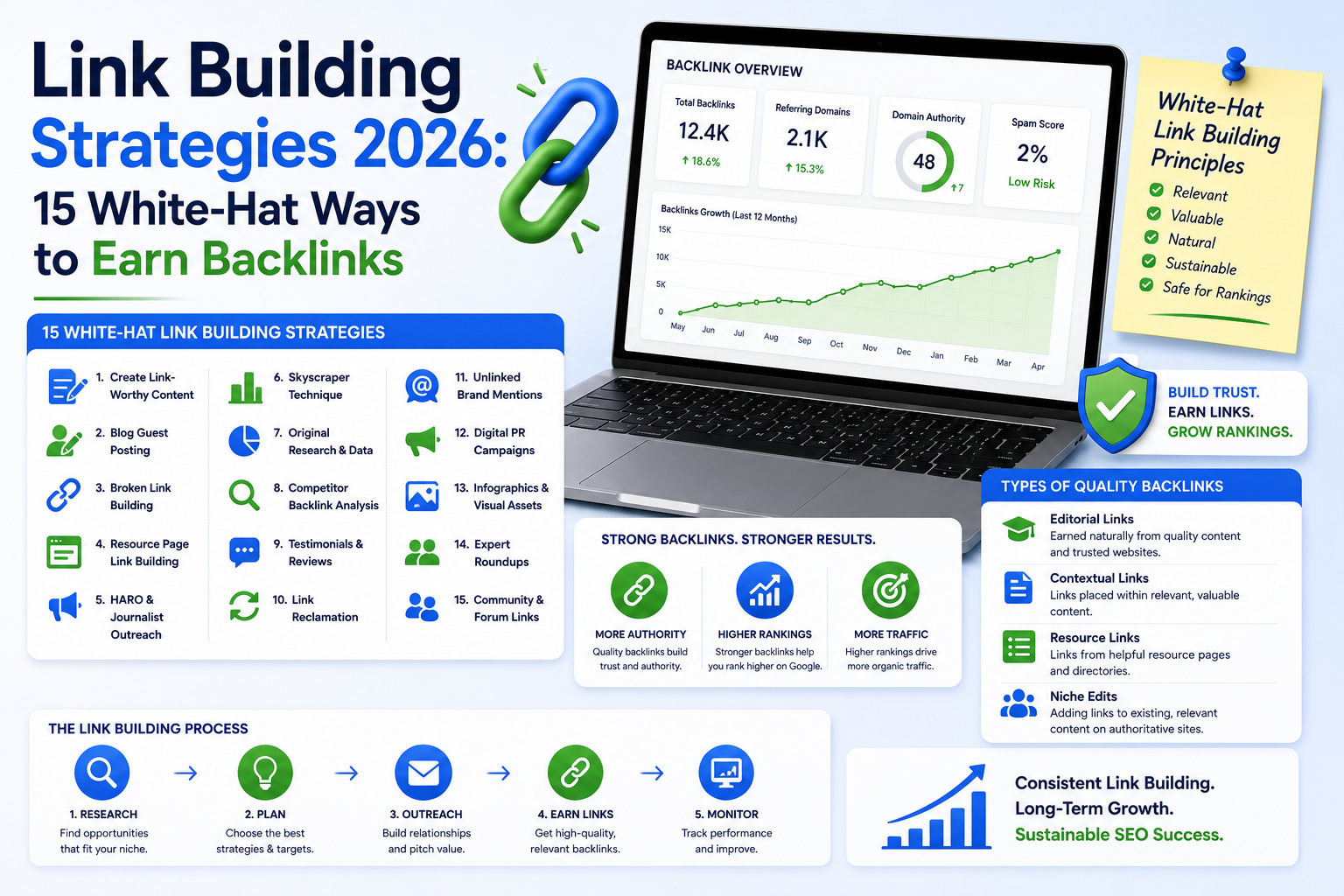
The most effective white-hat link building strategies in 2026 are digital PR with original data, journalist request platforms, creating linkable assets such as statistics pages, free tools and original research, strategic guest posting, reclaiming unlinked brand mentions, broken link building, supplier and partner links, local sponsorships, and podcast appearances. Quality, relevance, and editorial placement matter far more than raw link volume — ten relevant editorial links outperform a hundred directory submissions.
Introduction: Links Are Votes — And the Election Never Ends
Backlinks remain one of the strongest signals in Google’s ranking systems, and in 2026 they have taken on a second job: the third-party mentions that come with links also feed the consensus signals AI assistants use when deciding which brands to recommend. A link from a respected industry site is simultaneously a ranking vote, a referral channel, and evidence to language models that your brand is one worth citing.
Yet link building has the worst noise-to-signal ratio in all of marketing. Inboxes overflow with “high DA guest post cheap” spam, link sellers promise hundreds of placements, and the businesses that buy them eventually pay twice — once for the links and again when those links do nothing or trigger a manual action.
This guide cuts through the noise. These are the 15 strategies that actually work in 2026, all white-hat, ordered roughly from highest leverage to most situational. Pair them with the on-site fundamentals from our on-page SEO checklist — links amplify good pages; they cannot rescue bad ones.
What Makes a Backlink Valuable in 2026
Before the strategies, calibrate your targets. A link’s value is driven by:
| Factor | Strong Signal | Weak Signal |
| Relevance | Site and page are about your topic | Generic blog about everything |
| Authority | Established site with its own real links | New domain with inflated metrics |
| Placement | Editorial, in-content, contextual | Footer, sidebar, author-bio only |
| Traffic | Page ranks and gets visitors | Page exists only to host links |
| Anchor | Natural, varied, brand-heavy | Exact-match commercial repetition |
| Pattern | Diverse, earned over time | Sudden bursts from link networks |
One relevant editorial link from a site real people read beats fifty placements on link farms. Hold every opportunity below against this table.
Strategy 1: Digital PR With Original Data
The highest-ceiling tactic in modern link building. Journalists need statistics and stories; give them one. Survey your customers, analyse your internal data, or compile public datasets into something newsworthy (“We analysed 1,000 Indian D2C stores — 68% fail this Core Web Vitals check”). Package it with charts, a clear methodology, and quotable findings, then pitch journalists covering your industry. A single successful data story can earn dozens of authoritative links and brand mentions that keep compounding.
Strategy 2: Journalist Request Platforms
Reporters publicly request expert sources every day on platforms that replaced the old HARO model (Connectively-style services, Qwoted, Featured, SourceBottle, and journalist requests on X under #journorequest). Answer fast, answer specifically, include credentials, and skip self-promotion — the link comes from being quoted as an expert. Fifteen minutes of pitching daily reliably produces several authority links per month for consistent responders.
Strategy 3: Create Linkable Assets
Most pages have no reason to be linked to. Build pages that do:
- Statistics roundups. “Ecommerce SEO statistics 2026” pages attract links from every writer who needs a citation.
- Free tools and calculators. An ROI calculator or audit checklist earns links for years.
- Original research and benchmarks. See Strategy 1 — the asset is the engine.
- Definitive guides. The genuinely best resource on a topic becomes the default reference, the way comprehensive guides like our keyword research guide function inside a content cluster.
- Templates and checklists. Practical downloads that bloggers recommend to their readers.
Build one serious linkable asset per quarter and promote it with the outreach strategies below; assets without promotion are libraries without doors.
Strategy 4: Strategic Guest Posting
Guest posting still works when done for audiences instead of links. Target publications your customers actually read, pitch genuinely useful topics they have not covered, write your best material, and accept that one contextual link to a relevant resource is the fair exchange. Avoid sites that publish anyone for money, exist only to sell placements, or cover every topic under the sun — those links range from worthless to harmful.
Strategy 5: Reclaim Unlinked Brand Mentions
People already mention your brand, founders, and products without linking. Find these with Google Alerts and periodic searches for your brand name (minus your own domain), then send a short, friendly note asking for the link to be added. Conversion rates on reclamation outreach are the highest in link building because the hard part — earning the mention — is already done.
Strategy 6: Broken Link Building
Find dead pages on resource lists and articles in your niche, build or identify your equivalent content, and alert the site owner: “This link on your page is returning a 404 — we have a current guide on the same topic if useful.” You are doing them a favour and earning a relevant link in one email. Free crawler extensions surface broken outbound links on any resource page in seconds.
Strategy 7: Supplier, Partner, and Ecosystem Links
The most overlooked easy wins. Manufacturers list stockists; software companies showcase customers and certified partners; industry associations list members. Audit every business relationship you have — suppliers, platforms, tools you use, organisations you belong to — and request inclusion on their directories, case studies, and “where to buy” pages. These links are relevant, legitimate, and usually one email away. Ecommerce stores should start here, as we note in our Shopify SEO guide.
Strategy 8: Local Links and Sponsorships
For any business with a geography, local links punch far above their metrics: chambers of commerce, local business associations, community event sponsorships, college collaborations, local press stories, and “best of [city]” roundups. They strengthen both organic rankings and the local prominence signals behind map-pack results — the same signals our local SEO checklist builds systematically.
Strategy 9: Podcast and Webinar Appearances
Every podcast appearance typically yields a show-notes link, social mentions, and an audience hearing your expertise for an hour. Pitch shows your customers listen to with two or three specific episode ideas. Webinars and virtual summits work identically and often link from event pages that themselves rank.
Strategy 10: Skyscraper and Content Improvement Outreach
Identify content in your niche with many links but visible weaknesses — outdated data, missing sub-topics, poor formatting. Build the demonstrably better version, then reach out to sites linking to the original. Response rates are modest, so reserve this for keywords where the link gap genuinely blocks you, and lead outreach with what is new or corrected, not with flattery templates everyone deletes.
Strategy 11: Expert Roundups and Original Quotes — Both Directions
Contribute expert commentary to others’ roundups (links flow to contributors), and host your own roundups featuring respected names in your niche (contributors share and often link to their feature). The second direction also builds the relationships that make every other outreach strategy easier.
Strategy 12: Testimonials and Case Studies for Tools You Use
Vendors love social proof. Offer a genuine testimonial or detailed case study to the platforms and tools your business already uses; many publish them with a link to your site. Five minutes of writing for a relevant, legitimate link.
Strategy 13: Community Participation That Earns Citations
Genuine, helpful participation in Reddit, Quora, industry forums, and niche communities builds the brand mentions and occasional links that feed AI-consensus signals — increasingly valuable as assistants recommend brands they see discussed positively across the open web, a dynamic we unpack in our generative engine optimization guide. Hard-sell posting gets banned; consistently useful answers get cited.
Strategy 14: Internal Linking — The Free Authority You’re Ignoring
Before chasing the next external link, route the authority you already have. Every strong page on your site should pass internal links with descriptive anchors to the money pages you want to rank. Internal links are fully under your control, instantly implemented, and routinely move rankings on their own — the cheapest “link building” that exists.
Strategy 15: Competitor Backlink Replication
Export your top competitors’ backlinks (free-tier backlink checkers suffice for the top links), identify the earnable ones — resource lists, directories, roundups, publications accepting contributors — and pursue each through the matching strategy above. You are not copying their strategy; you are letting their history reveal which doors in your niche are open.
Anchor Text Strategy and Measuring Link Quality
Two craft details separate professional campaigns from amateur ones.
Anchor text distribution. The links you earn naturally skew toward branded anchors (“Webin Marketing”), naked URLs, and generic phrases (“this guide”) — and that natural skew is exactly the safe profile. Where you have influence (guest posts, asset outreach), prefer descriptive partial-match anchors (“white-hat link building strategies”) over exact-match commercial phrases, and never repeat the same money anchor across many domains. A profile of 60–70% branded and natural anchors, with descriptive variation making up the rest, mirrors how the web links organically and survives every link-spam system.
Judging links before you chase them. Metrics like DA/DR are third-party estimates that spammers inflate; use them as a coarse filter, never the decision. The five-minute manual check beats any metric: Does the site rank for anything in its own niche? Does the page that would link to you have organic traffic or internal links itself? Is the outbound link profile clean or a casino-and-CBD junk drawer? Would a real reader plausibly click the link to you? Four yes answers make a link worth pursuing at almost any metric; four no answers make it worthless at DA 70.
Reporting that means something. Track monthly: new referring domains (relevant ones, counted manually if needed), links to priority money pages specifically, ranking movement on the keywords those pages target, and referral conversions in GA4. A campaign producing twenty relevant referring domains and two page-one movements in a quarter is succeeding; one producing two hundred junk domains and no movement is theatre.
What to Avoid: The Tactics That Cost More Than They Pay
- Buying bulk link packages from marketplaces and “high DA” spam emails
- Private blog networks (PBNs) — link patterns are exactly what spam systems detect
- Mass exact-match anchors pointing at commercial pages
- Irrelevant directory blasts and comment/forum spam
- Reciprocal link schemes at scale
Google’s spam policies explicitly cover link schemes, and the SpamBrain systems neutralise or penalise manipulative patterns. The honest math: money spent on one quarter of digital PR outperforms a year of bought links — without the risk.
Your 90-Day Link Building Plan
| Weeks | Focus | Output |
| 1–2 | Foundations | Internal link audit complete; supplier/partner list emailed; Google Alerts live |
| 3–4 | Quick wins | Unlinked mentions reclaimed; testimonial links requested; journalist platforms joined, daily pitching begins |
| 5–8 | Asset build | One linkable asset (data study, tool, or statistics page) created and published |
| 9–12 | Promotion | Asset outreach to 100 relevant sites; two guest posts placed; one podcast booked; broken-link campaign in niche |
Expect the first links in weeks 2–4 from reclamation and ecosystem requests, with the asset campaign compounding from month three onward. Track new referring domains monthly, but judge success by referring-domain *relevance* and the ranking movement of target pages.
A Note on Velocity and Patience
Natural link profiles grow unevenly — a data study lands and twenty links arrive in a fortnight, then a quiet month follows. That lumpiness is normal and safe; what triggers scrutiny is sustained artificial patterns from the same networks. Plan campaigns in quarterly pulses around assets, keep the always-on lanes (journalist pitching, reclamation, ecosystem requests) ticking weekly, and judge the program on six-month trend lines rather than weekly counts.
Frequently Asked Questions About Link Building
How many backlinks do I need to rank?
Are directory links worthless?
Is guest posting dead in 2026?
Should I disavow bad links?
How long until links affect rankings?
Do nofollow links matter?
Conclusion: Earn Votes, Don’t Buy Them
Link building in 2026 rewards exactly what it was always supposed to reward: being genuinely useful, quotable, and connected in your niche. Build assets worth citing, make yourself easy to quote, reclaim what you have already earned, and route your internal authority deliberately — and the votes accumulate while your link-buying competitors tread water.
If you want this run as a managed campaign — digital PR, assets, outreach, and reporting — Webin Marketing’s SEO services build white-hat link acquisition programs for businesses across India and worldwide. Book a free strategy call and we will show you the specific link gaps between you and the competitors outranking you.
Affiliate Disclosure
Some links in this article may be affiliate links. If you purchase a tool or service through these links, Webin Marketing may earn a small commission at no extra cost to you. We only recommend tools we have tested or genuinely believe add value to our readers.
Disclaimer
This article is for informational and educational purposes only. Search engine policies on links change and are enforced algorithmically and manually; no agency can guarantee specific rankings or link outcomes. Avoid any tactic that violates current Google spam policies, and evaluate every link opportunity on relevance and legitimacy before pursuing it.