
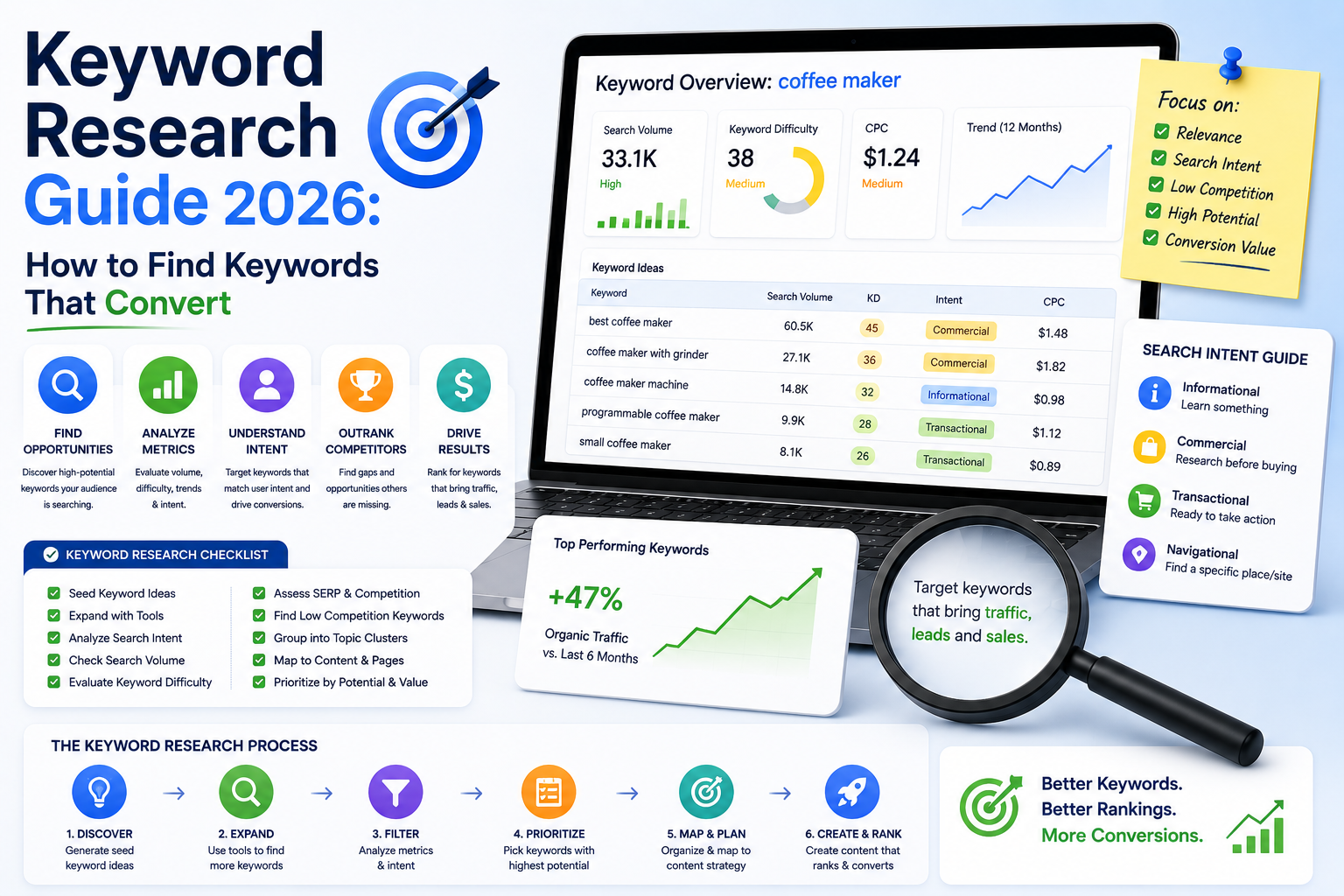
Keyword research in 2026 is the process of discovering the exact words and questions your customers type or speak into search engines and AI assistants, then prioritising them by intent, difficulty, and business value. The core workflow: brainstorm seed topics, expand with autocomplete, People Also Ask and keyword tools, classify each keyword by search intent, assess difficulty against your site’s authority, map one primary keyword per page, and revisit quarterly as demand shifts.
Introduction: Rankings Don’t Pay Bills — The Right Rankings Do
Most failed SEO campaigns die at the very first step. The site ranks — for keywords nobody searches, or worse, keywords searched by people who will never buy. Meanwhile a competitor ranking for a fraction of the traffic captures all the customers, because they chose terms with buying intent.
Keyword research is the targeting system for everything that follows: your content calendar, your page structure, your internal linking, even your paid campaigns. Done well, it tells you exactly what to create, in what format, in what order, and what each ranking is worth. Done badly — or skipped — every hour of writing and link building afterwards is aimed at the wrong target.
In this guide, Webin Marketing walks you through the complete 2026 keyword research workflow, entirely possible with free tools (our companion piece on SEO without paid tools covers the toolkit in detail). Whether you run a Shopify store, a local service business, or a content site, the process is the same six steps.
Step 1: Build Your Seed List
Seeds are the broad topics everything expands from. Gather them from:
- Your offers. Every service, product category, and problem you solve.
- Customer language. Sales calls, support tickets, WhatsApp enquiries, and reviews — copy the exact phrases customers use, which often differ from industry jargon.
- Competitors. The navigation menus and blog categories of the three sites you most want to beat.
- Communities. Reddit threads, Quora questions, and Facebook groups in your niche reveal the questions people ask before they ever search.
Aim for 15–30 seed terms. “Shopify SEO,” “abandoned cart,” “product photography” — broad enough to expand, specific enough to be yours.
Step 2: Expand Each Seed Into Hundreds of Keywords
Now multiply each seed using free expansion sources:
- Google Autocomplete. Type the seed plus each letter of the alphabet (“keyword research a…”, “keyword research b…”) and harvest the suggestions — these are real, current queries.
- People Also Ask. Click PAA questions to load more; each one is a proven question worth a section or an article.
- Related Searches at the bottom of results pages.
- Google Keyword Planner. Free with any Google Ads account; gives volume ranges and hundreds of related ideas per seed.
- Google Trends. Compare candidates, catch seasonality, and spot rising terms before tools show volume.
- AI assistants. Ask ChatGPT or Gemini “list 30 questions someone researching [topic] would ask” — excellent for long-tail and conversational queries that now flow through AI search, a shift we analyse in our GEO guide.
- Search Console (if your site has history). The Queries report shows keywords you already rank #5–#20 for — the fastest wins in all of SEO.
Tag each keyword with its source as you go — autocomplete, PAA, Planner, Search Console — because source patterns later reveal which discovery channels produce your winners. Dump everything into a spreadsheet. A few hundred raw keywords per seed cluster is normal; filtering comes next.
Step 3: Classify Every Keyword by Search Intent
Intent is the single most important attribute of a keyword — it determines what page type can rank and what the traffic is worth.
| Intent Type | The Searcher Wants To… | Example | Page Type That Ranks | Business Value |
| Informational | Learn something | “what is keyword research” | Blog post, guide | Builds audience and authority |
| Commercial | Compare before buying | “best keyword research tools” | Listicle, comparison, review | High — close to purchase |
| Transactional | Buy or act now | “hire SEO agency Ahmedabad” | Service page, product page | Highest — direct revenue |
| Navigational | Reach a specific site | “webin marketing blog” | Your own brand pages | Protect, don’t chase others’ |
The fastest way to confirm intent: search the keyword and look at what Google rewards. If the top five results are listicles, the intent is commercial comparison — and your service page will not rank there no matter how optimized it is. Matching page type to intent is the rule that overrides every other tactic, as we stress throughout our on-page SEO checklist.
Step 4: Prioritise — Volume Is the Least Important Number
Beginners sort by search volume; professionals score keywords across four dimensions:
- Business value. What is a visitor from this keyword worth? “free logo maker” may have huge volume and zero buyers; “logo design services price” converts.
- Intent stage. Transactional and commercial keywords feed revenue this quarter; informational keywords feed the list and the authority that compound later. Healthy strategies target both deliberately.
- Difficulty relative to YOUR site. Ignore abstract difficulty scores in isolation. Search the keyword: if every result is a high-authority brand with thousands of links and your site is six months old, move on. If you see forums, thin pages, or outdated posts in the top ten, that keyword is winnable.
- Long-tail leverage. Specific multi-word queries (“keyword research for shopify store india”) have lower volume but higher conversion, weaker competition, and — increasingly — direct overlap with how people phrase questions to AI assistants. The long tail collectively outweighs head terms for almost every small and mid-sized site.
A simple scoring column (1–5 on value, winnability, and strategic fit) turns a thousand-row spreadsheet into a ranked action list in an hour.
Step 5: Map Keywords to Pages (One Primary Keyword Per Page)
Keyword mapping converts your list into a site plan and prevents the most common self-inflicted wound in SEO — cannibalisation, where multiple pages compete for the same query and all underperform.
Rules of mapping:
- One primary keyword per page. Closely related variants (“keyword research guide,” “how to do keyword research”) share one page; distinct intents get distinct pages.
- Match the page type to the intent you confirmed in Step 3.
- Cluster around pillars. Group keywords into topic clusters: a pillar page targets the head term, supporting articles target the sub-questions, and everything interlinks. This hub structure builds the topical authority that modern ranking systems — and AI retrieval — reward.
- Record secondary keywords per page: the PAA questions and variants each article should answer in its H2s.
- Assign existing pages first. Before planning new content, map keywords your current pages could win with optimization — updating an existing page outpaces publishing a new one almost every time.
Your finished map becomes the content calendar: URL, primary keyword, intent, page type, secondary questions, internal links in and out, priority score.
Step 6: Validate, Track, and Refresh Quarterly
Keyword research is a loop, not a one-time project.
- Track rankings and Search Console queries monthly. Watch which mapped keywords move and which pages attract unexpected queries worth their own content.
- Mine the “almost ranking” report. Filter Search Console for positions 5–20: these pages need on-page improvements and internal links, not new content.
- Re-check intent yearly. Google reshuffles what page types rank; a keyword that rewarded blog posts last year may reward product pages now.
- Watch demand shifts in Trends. Rising terms in your niche deserve early content while competition is thin — first-mover pages on growing queries compound for years, a dynamic we covered in our 2026 digital marketing trends analysis.
Keyword Research for Local and Ecommerce Businesses
The six-step workflow holds everywhere, but two business types deserve tailored notes.
Local service businesses. Your keyword universe is service × location × modifier. Build the matrix explicitly: every service you offer crossed with every area you serve, plus modifiers like “near me,” “cost,” “best,” and “emergency.” Intent skews heavily transactional, and the SERPs split between map-pack results and organic pages — meaning your Google Business Profile categories and your location pages are both keyword targets. Mine the Q&A and reviews of competitors’ profiles for the exact phrases customers use, and target question keywords (“how much does logo design cost in Ahmedabad”) with FAQ content that feeds both featured snippets and AI answers. Our local SEO checklist shows where each keyword type lives on a local site.
Ecommerce stores. Map the keyword layers to your architecture: head category terms to collections, mid-tail to sub-collections and filtered pages you deliberately index, long-tail buying queries to products, and informational queries to the blog that links into all of them. Marketplace search bars are an extra goldmine — Amazon and Flipkart autocomplete reveal purchase-phrased queries with proven buyer demand that web tools underreport. Watch for modifier patterns that signal high intent in your niche (“for oily skin,” “under 2000,” “with warranty”) and ensure your product copy actually contains the attributes people filter by; the keyword research and the on-page coverage are the same exercise seen from two sides.
In both cases the discipline is identical: let the structure of demand dictate the structure of the site, not the other way round. Once the matrix exists, audit it yearly: services launch, areas expand, product lines rotate, and seasonal demand (festive gifting, tax season, monsoon services) creates predictable keyword windows worth preparing content for sixty days in advance. The businesses that treat the keyword matrix as a living document capture each wave while competitors are still reacting to it.
Free Keyword Research Toolkit (2026)
| Tool | Best For | Cost |
| Google Keyword Planner | Volume ranges, idea expansion | Free |
| Google Autocomplete + PAA | Real query phrasing, questions | Free |
| Google Trends | Seasonality, rising topics, comparisons | Free |
| Google Search Console | Keywords you already almost rank for | Free |
| AI assistants (ChatGPT/Gemini) | Long-tail and conversational expansion | Free tiers |
| AnswerThePublic-style tools | Question visualisation | Free tier |
| Keyword Surfer / similar extensions | Volume estimates in-SERP | Free |
Paid suites add scale, click data, and competitor depth — useful for agencies, optional for a single site. Strategy beats tooling; a disciplined spreadsheet outperforms an unused subscription. For the broader free stack we run, see our agency tools roundup.
From Spreadsheet to Calendar: Operationalising Your Research
Research only pays when it ships. Convert your finished keyword map into a publication calendar with three lanes: quick wins (existing pages at positions 5–20 needing optimization and internal links — schedule these first, they pay within weeks), revenue pages (transactional and commercial targets where new or rebuilt pages directly feed sales), and authority builders (the informational cluster content that earns links, answers PAA questions, and feeds AI citations). A sustainable cadence for a small team is two quick wins, one revenue page, and two cluster articles per month — modest on paper, transformative after two quarters because every piece lands on a pre-validated target. Review the calendar against Search Console monthly, promote keywords that start moving, and retire targets the data disproves. The spreadsheet is the map; the calendar is the journey.
Keyword Research Mistakes That Waste Months
- Chasing head-term volume your site cannot win for years
- Ignoring intent and pointing blog posts at transactional queries (or vice versa)
- Creating a new page for every keyword variant — cannibalisation by enthusiasm
- Treating zero-volume long-tails as worthless when they convert at 10x
- Copying a competitor’s keywords without their authority to rank for them
- Researching once at launch and never revisiting as demand shifts
- Forgetting AI search: conversational questions now deserve explicit targeting
Frequently Asked Questions About Keyword Research
How many keywords should I target per page?
Are long-tail keywords worth it with such low volume?
How do I know if a keyword is too competitive?
Is search volume data accurate?
How is keyword research different for AI search?
How often should keyword research be redone?
Conclusion: Aim Before You Fire
Every piece of content you will publish this year is a shot — keyword research is the aiming. Spend the day building your seed list, expanding it, classifying intent, scoring winnability, and mapping one keyword per page, and you will know precisely what to create and why for the next two quarters. Skip it, and you are writing into the dark.
Want the targeting done by specialists? Webin Marketing’s SEO services include complete keyword research, clustering, and content mapping for businesses across India and worldwide — delivered as a ready-to-execute calendar. Book a free strategy call and we will show you the keywords your competitors are winning that you are not even targeting yet.
Affiliate Disclosure
Some links in this article may be affiliate links. If you purchase a tool or service through these links, Webin Marketing may earn a small commission at no extra cost to you. We only recommend tools we have tested or genuinely believe add value to our readers.
Disclaimer
This article is for informational and educational purposes only. Search behaviour, tools, and ranking systems change frequently, and no agency can guarantee specific rankings or traffic outcomes. Keyword data from any tool is an estimate; validate against your own Search Console data wherever possible.