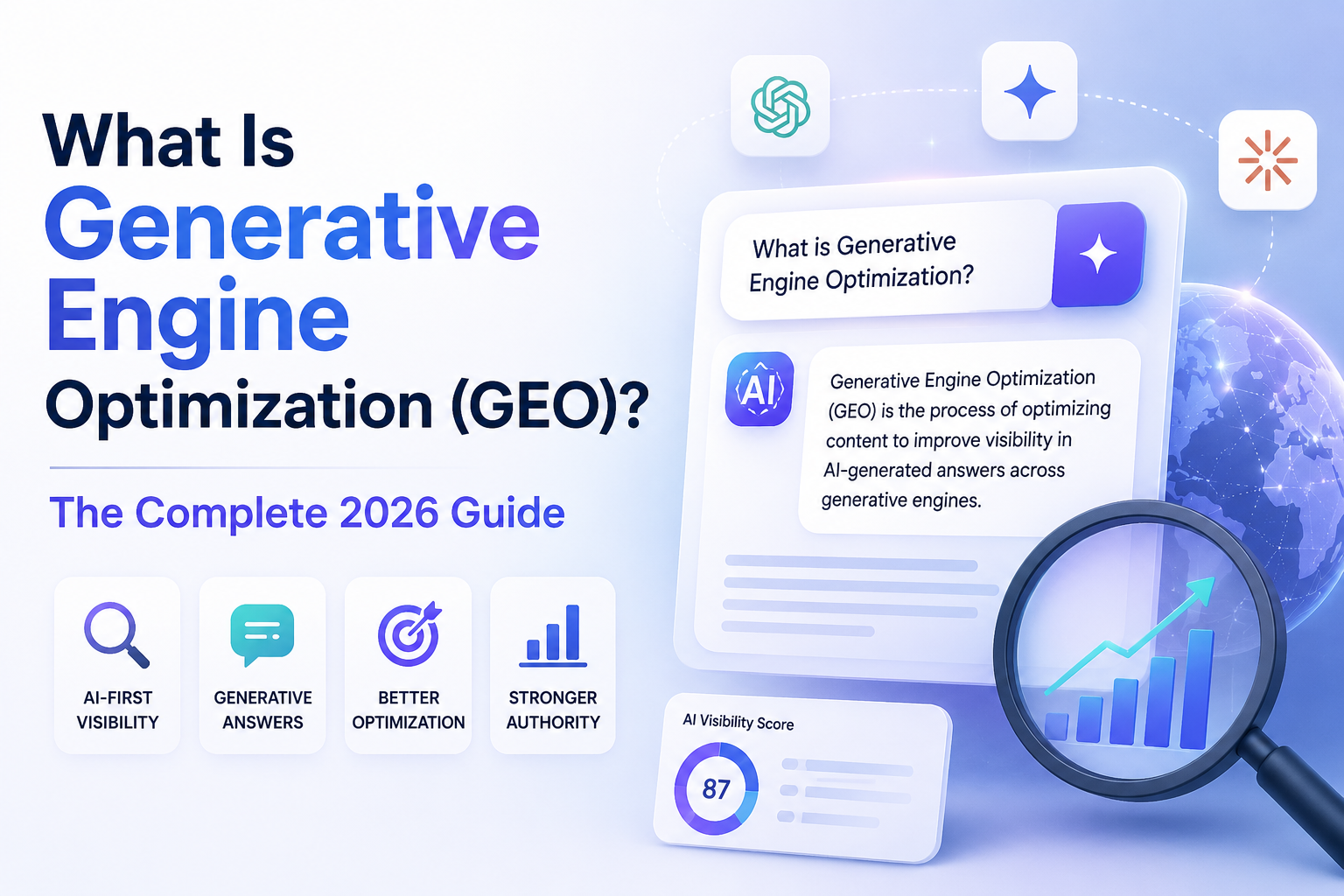
Generative Engine Optimization (GEO) is the practice of optimizing your content so that AI-powered search engines — such as Google AI Overviews, ChatGPT, Perplexity, and Gemini — cite, quote, and recommend your brand in their generated answers. Unlike traditional SEO, which targets ranked blue links, GEO targets *citations inside AI answers* by using clear structure, direct answers, statistics, expert quotes, schema markup, and strong topical authority.
Introduction: Search Has Changed — Has Your Content?
For two decades, winning at search meant one thing: ranking in the top ten blue links on Google. In 2026, that game has fundamentally changed. A growing share of searches now end without a single click, because users get their answer directly from an AI-generated response at the top of the page. Google’s AI Overviews now appear on a large percentage of informational queries, while millions of users have shifted part of their search behaviour entirely to tools like ChatGPT, Perplexity, Claude, and Gemini.
This shift created an entirely new discipline: generative engine optimization (GEO). If traditional SEO is about convincing an algorithm to rank your page, GEO is about convincing a language model to *cite* your page when it writes an answer. Brands that master GEO early are capturing visibility their competitors do not even know exists yet.
In this complete guide, Webin Marketing explains exactly what generative engine optimization is, how it differs from classic SEO, which factors influence AI citations, and a practical 12-step framework you can start implementing today. If you are new to search marketing, we recommend first reading our beginner-friendly guide on what SEO is in digital marketing, then coming back here.
What Is Generative Engine Optimization (GEO)?
Generative engine optimization (GEO) is the process of structuring, writing, and promoting content so that generative AI systems select it as a source when answering user questions. The term gained popularity after a 2023 research paper from Princeton, Georgia Tech, and IIT Delhi tested which content changes increased visibility inside AI-generated answers — and found that adding statistics, quotations, and citations could improve visibility by up to 40 percent.
In simple words: when someone asks ChatGPT “best Shopify SEO agency in India” or Google’s AI Overview answers “how to improve email open rates,” GEO determines whether *your* website is one of the sources mentioned in that answer.
GEO goes by several names in the industry — AI search optimization, answer engine optimization (AEO), and LLM optimization — but the goal is identical: earning citations and brand mentions inside AI-generated responses.
Why GEO Matters in 2026
- Zero-click search is rising. A majority of informational queries now end without a website visit, so the AI answer itself becomes the battlefield for attention.
- AI assistants influence buying decisions. Users increasingly ask ChatGPT and Perplexity for product, agency, and software recommendations before they ever open Google.
- Citations build outsized trust. Being named by an AI assistant works like an instant third-party endorsement of your brand.
- Early movers win disproportionately. Most businesses have not adapted yet, which means the citation space in your niche is still relatively uncrowded.
- Traditional rankings feed AI answers. Strong SEO remains the foundation — AI systems still draw heavily from pages that already rank well, as Google explains in its own AI features documentation.
GEO vs SEO: What Is the Difference?
GEO does not replace SEO — it extends it. The fundamentals of crawlability, content quality, and authority still apply, but the optimization target changes. The table below summarises the key differences.
| Factor | Traditional SEO | Generative Engine Optimization (GEO) |
| Primary goal | Rank in top 10 blue links | Get cited inside AI-generated answers |
| Target system | Search engine ranking algorithms | Large language models and retrieval systems |
| Success metric | Rankings, organic clicks, CTR | Citations, brand mentions, share of AI answers |
| Content style | Keyword-targeted long-form pages | Direct answers, structured facts, quotable statements |
| Key signals | Backlinks, keywords, page experience | Statistics, quotes, entities, structure, consensus mentions |
| Traffic pattern | Click-through to website | Brand visibility, assisted conversions, referral clicks from citations |
| Measurement tools | Search Console, rank trackers | AI visibility trackers, brand monitoring, manual prompt testing |
The smartest strategy in 2026 is a hybrid one: keep doing the SEO work that earns rankings, and layer GEO techniques on top so the same content also wins citations. Our team covers this convergence in detail in our post on the top digital marketing trends to watch in 2026.
How Generative Engines Choose Their Sources
To optimize for generative engines, you first need to understand how they actually build answers. Most AI search systems follow a process called retrieval-augmented generation (RAG):
- The user asks a question in natural language.
- The system rewrites the query into multiple search-style sub-queries (this is called query fan-out).
- A retrieval layer pulls candidate documents — often from a traditional search index like Google or Bing.
- The language model reads those candidates and synthesises an answer.
- The system attaches citations to the sources it relied on most.
This process reveals three crucial truths for marketers. First, if you do not rank anywhere, you usually cannot be retrieved — which is why classic SEO remains the entry ticket. Second, the model prefers passages it can lift cleanly: short, factual, well-structured chunks beat long rambling paragraphs. Third, consensus matters: if your brand is mentioned across many independent sources (review sites, directories, news, Reddit, YouTube), the model treats you as a safer answer to recommend.
The 12-Step GEO Framework for 2026
Here is the exact framework we use at Webin Marketing to improve AI visibility for our clients. You can implement most of it with free tools — see our guide on how to do SEO without paid tools for the supporting toolkit.
Step 1: Start Every Page with a Direct Answer
Place a 40–70 word “quick answer” block immediately under your H1 that directly answers the main question of the page. AI systems love extractable summaries, and this same block frequently wins featured snippets too. Write it the way you would want it quoted.
Step 2: Use Question-Based Headings
Structure your H2s and H3s as the real questions users ask: “What is GEO?”, “How much does Shopify SEO cost?”, “Is email marketing still effective in 2026?”. This mirrors the query fan-out behaviour of AI systems and makes each section independently citable.
Step 3: Add Statistics and Cite Your Sources
The original GEO research found that adding relevant statistics was one of the strongest visibility boosters. Include specific numbers, percentages, and dates — and link to credible primary sources. Pages that cite authorities such as Search Engine Land or peer-reviewed research are themselves treated as more trustworthy.
Step 4: Include Expert Quotes
Quotations from named experts increase the “quotability” of your content. Add insights from your founders, your team, or industry voices, with full names and titles. This also strengthens E-E-A-T (Experience, Expertise, Authoritativeness, Trustworthiness), which Google describes in its Search Quality Rater Guidelines.
Step 5: Structure Content in Liftable Chunks
Keep paragraphs under four lines. Use bullet lists, numbered steps, and comparison tables. Every section should make sense even when read in isolation, because AI systems retrieve *passages*, not whole pages.
Step 6: Implement Schema Markup
Add Article, FAQPage, HowTo, Organization, and Product schema where relevant. Structured data helps machines understand entities and relationships on your page. Validate everything with Google’s Rich Results Test.
Step 7: Build Entity-Rich About and Author Pages
AI systems reason in entities — people, brands, places, products. Create a detailed About page, individual author bios with credentials, and consistent NAP (name, address, phone) details. Connect your entity across LinkedIn, Crunchbase, Wikipedia-style profiles, and your Google Business Profile.
Step 8: Earn Mentions Beyond Your Website
Citations in AI answers correlate strongly with third-party mentions. Pursue digital PR, guest contributions, podcast appearances, directory listings, and genuine participation in communities like Reddit and Quora. The wider the consensus that your brand is relevant, the more confidently models recommend you.
Step 9: Create Comparison and “Best X” Content
Generative engines are constantly asked “what is the best…” and “X vs Y” questions. Publishing honest, well-researched comparison pages positions your content as the raw material for those answers.
Step 10: Keep Content Fresh and Dated
Display visible “last updated” dates and refresh key statistics at least twice a year. AI systems and their retrieval layers show measurable preference for current content, especially on fast-moving topics like AI itself — a trend we documented in our article on how AI is transforming digital advertising.
Step 11: Ensure AI Crawlers Can Access Your Site
Check your robots.txt: many sites accidentally block GPTBot, ClaudeBot, PerplexityBot, or Google-Extended. Decide deliberately which AI crawlers you allow, keep your pages fast and server-side rendered where possible, and maintain a clean XML sitemap.
Step 12: Measure Your AI Visibility
Test 20–30 high-value prompts each month in ChatGPT, Perplexity, Gemini, and Google AI Overviews. Record whether your brand appears, which competitors are cited, and which pages earn the citations. Track referral traffic from AI domains in GA4 and watch branded search volume as a proxy for AI-driven awareness.
GEO Content Checklist (Copy This)
| Element | Requirement | Done? |
| Quick answer block | 40–70 words directly under H1 | ☐ |
| Question-based H2/H3s | Match real user phrasing | ☐ |
| Statistics | Minimum 3–5 with linked sources | ☐ |
| Expert quote | At least one named expert | ☐ |
| Table or list | At least one per major section | ☐ |
| FAQ section | 4–6 questions with concise answers | ☐ |
| Schema markup | Article + FAQPage validated | ☐ |
| Author bio | Name, credentials, photo, links | ☐ |
| Updated date | Visible and accurate | ☐ |
| Internal links | 3–6 to related cluster content | ☐ |
| External links | 2–4 to authoritative sources | ☐ |
Common GEO Mistakes to Avoid
- Abandoning SEO fundamentals. GEO without rankings is a house without a foundation; retrieval still depends on indexable, ranking content.
- Writing for word count instead of clarity. Bloated intros and fluffy transitions actively hurt passage-level retrieval.
- Keyword stuffing. Language models understand synonyms and context; unnatural repetition reads as low quality.
- Ignoring brand mentions off-site. A perfect page on an unknown brand still loses to a mediocre page on a widely-mentioned brand.
- Blocking AI crawlers unintentionally. Audit robots.txt before assuming your content is even reachable.
- Never measuring. Without monthly prompt testing, you are optimizing blind.
Free and Paid Tools for GEO in 2026
You do not need an expensive stack to begin. Here is the practical toolkit, ordered from free essentials to optional paid accelerators:
| Tool Type | Free Options | What It Does for GEO |
| Search performance | Google Search Console | Confirms which pages rank well enough to be retrieved by AI systems |
| Schema validation | Rich Results Test, Schema.org validator | Verifies your structured data is readable by machines |
| Prompt testing | ChatGPT, Perplexity, Gemini (free tiers) | Manual monthly checks of brand citations across a fixed prompt set |
| Analytics | GA4 | Tracks referral sessions arriving from AI platforms and assisted conversions |
| Brand monitoring | Google Alerts | Flags new third-party mentions that strengthen consensus signals |
| AI visibility tracking | Paid trackers (optional) | Automates citation monitoring across hundreds of prompts and competitors |
Start with the free row stack, run it for a quarter, and only add paid tracking once your prompt list outgrows manual testing. The discipline of measurement matters far more than the sophistication of the tool.
How Long Does GEO Take to Show Results?
Based on our client work, expect the first measurable AI citations within 6–12 weeks for low-competition topics, and 4–6 months for competitive commercial queries. Brand-mention building (Step 8) is usually the slowest lever but also the most durable. Because AI answers often draw from a small set of trusted sources, displacing an incumbent citation takes consistent publishing, freshness, and authority growth — there are no overnight hacks, and anyone promising guaranteed AI citations should be treated with the same scepticism as anyone promising guaranteed #1 rankings.
Frequently Asked Questions About GEO
Is GEO replacing SEO?
What does GEO stand for in marketing?
Do I need new tools for GEO?
Does GEO work for local businesses?
How do I measure GEO success?
Can small websites win AI citations against big brands?
Conclusion: Win the Answer, Not Just the Ranking
Generative engine optimization is not a buzzword — it is the natural evolution of search marketing in an AI-first world. The brands that adapt their content for direct answers, structured data, statistics, and off-site authority will own the citations that millions of AI-generated answers are built from. The brands that wait will discover that the most valuable real estate in search no longer has a rank tracker.
Start small: pick your ten most important pages, apply the 12-step framework above, and measure monthly. If you would rather have specialists handle it, the SEO services team at Webin Marketing builds combined SEO + GEO strategies for businesses across India and globally. Book a free strategy call and we will show you exactly where your brand stands in AI search today.
Affiliate Disclosure
Some links in this article may be affiliate links. If you purchase a tool or service through these links, Webin Marketing may earn a small commission at no extra cost to you. We only recommend tools we have tested or genuinely believe add value to our readers.
Disclaimer
This article is for informational and educational purposes only. Search engine and AI platform algorithms change frequently, and no agency can guarantee specific rankings, citations, or traffic outcomes. Results vary based on industry, competition, and implementation. Always conduct your own research before making business or investment decisions based on this content.